About this experiment
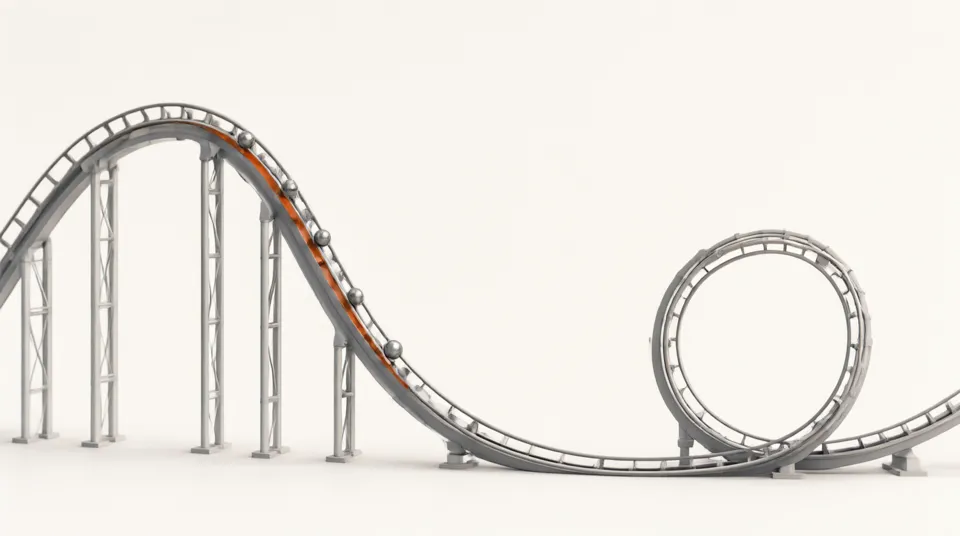
Release a ball on a curved track and watch its energy change form. Without friction, kinetic and potential energy trade places while the total stays exactly the same, so the ball always climbs back to its starting height. Add friction and a growing share turns into thermal energy, the swings get smaller and the ball finally comes to rest. The bar chart and the energy-time graph make every joule visible.
Learning goals
- Describe how gravitational potential energy and kinetic energy change as an object moves up and down a slope
- Show that the total mechanical energy stays constant when there is no friction
- Use energy conservation to predict the speed at the bottom of a track
- Explain where the "lost" energy goes when friction acts
How to use it
- 1Keep friction at zero, drag the ball to a height of 4 m and press Play.
- 2Compare the kinetic and potential energy bars at the highest and lowest points.
- 3Change the mass and the gravity. Predict the speed at the bottom before you release the ball again.
- 4Raise the friction coefficient and follow how the thermal energy bar grows until the ball stops.
The model
Assumptions
- The ball is treated as a point mass that slides along the rail and never leaves it. Rolling and spin are ignored.
- Air resistance is ignored. Friction is kinetic friction μN, and the ball stays at rest when the slope is gentle enough for friction to hold it.
- Potential energy is measured from the dashed ground line, where h = 0.
- The motion is integrated with a fourth-order Runge-Kutta method in 1 ms steps, so the total energy stays constant to about one part in a million.
Try this in class
- Q1Without friction, how high does the ball climb on the other side? Does the shape of the track matter?
- Q2A 1 kg and a 5 kg ball are released from the same height. Which is faster at the bottom?
- Q3On the double dip track, what is the lowest release height that lets the ball cross the middle hump?
- Q4With friction on, the total energy bar stays the same height. Where has the energy gone when the ball stops?
Frequently asked questions
Why does the speed not depend on the mass?
Both the potential energy lost and the kinetic energy gained are proportional to mass, so the mass cancels in mgh = ½mv².
Is mechanical energy conserved with friction?
No. Mechanical energy, the sum of kinetic and potential energy, decreases. Total energy is still conserved because the missing amount appears as thermal energy in the ball and the track.
Why is the ground line chosen as zero potential energy?
Any level can be chosen as zero. Only changes in potential energy matter for the motion, so moving the zero shifts every value by the same amount and does not change the result.