About this experiment
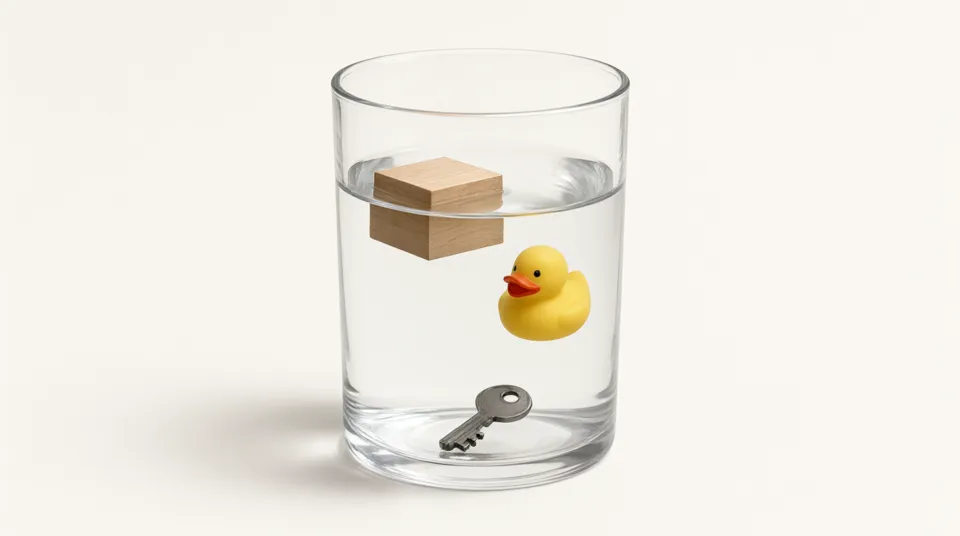
Will it float or will it sink? Many children think heavy things sink and light things float, but a big apple floats while a tiny coin sinks. What matters is what the object is made of and how much space it takes up. Drag everyday objects into a tub of water, guess first and check, then add salt to the water and see an egg come up to the surface.
Learning goals
- Sort everyday objects into those that float and those that sink
- Make a prediction and check it with a fair test
- Explain that heavy objects can float and light objects can sink
- Explain that changing the shape of a material can make it float
- Notice that objects float higher in salty water
How to use it
- 1Choose Predict first. For each object, guess whether it will float or sink, then watch. How many did you get right?
- 2Compare the apple and the coin. Which is heavier? Which floats?
- 3Put the clay ball and the clay boat in the water. They are made of the same clay and have the same mass. What is different?
- 4Look at the ice cube and the wooden block. Which one has more of itself under the water?
- 5Put the egg in tap water, then change to salty water. What happens?
- 6Sort all the objects into two groups. What do the objects that sink have in common?
The model
Assumptions
- Each object has a typical density. Real apples, stones and eggs vary, and a very fresh egg sinks more quickly than an old one.
- The clay boat and the closed bottle are treated as one object with the air inside them, which lowers their average density.
- Tap water has a density of 1.00 g/cm³; the salty water has a lot of salt dissolved in it and a density of 1.10 g/cm³.
- The objects do not soak up water, so they float at the same height for as long as you watch.
Try this in class
- Q1Why does a huge ship made of steel float when a small steel key sinks?
- Q2How could you make a ball of clay float without taking any clay away?
- Q3An egg sinks in a glass of tap water. What could you add to the water to make it float?
- Q4Why is it easier to float when swimming in the sea than in a swimming pool?
- Q5Most of an iceberg is under the water. Use the ice cube to explain why.
Frequently asked questions
Is it true that heavy things sink?
Not always. A large log is much heavier than a small pebble, but the log floats and the pebble sinks. Whether something floats depends on how heavy it is for its size, which scientists call density.
Why does the clay boat float when the clay ball sinks?
The boat shape holds a lot of air and pushes aside much more water than the ball does. Together, the clay and the air inside the boat are less dense than water, so the water can hold the boat up.
How do I set up this activity in the classroom?
Use a clear tub of water and real objects like these. Let pupils record their predictions in a table before testing each one, then discuss any surprises. Dissolve plenty of salt in a jug of water to repeat the egg test.