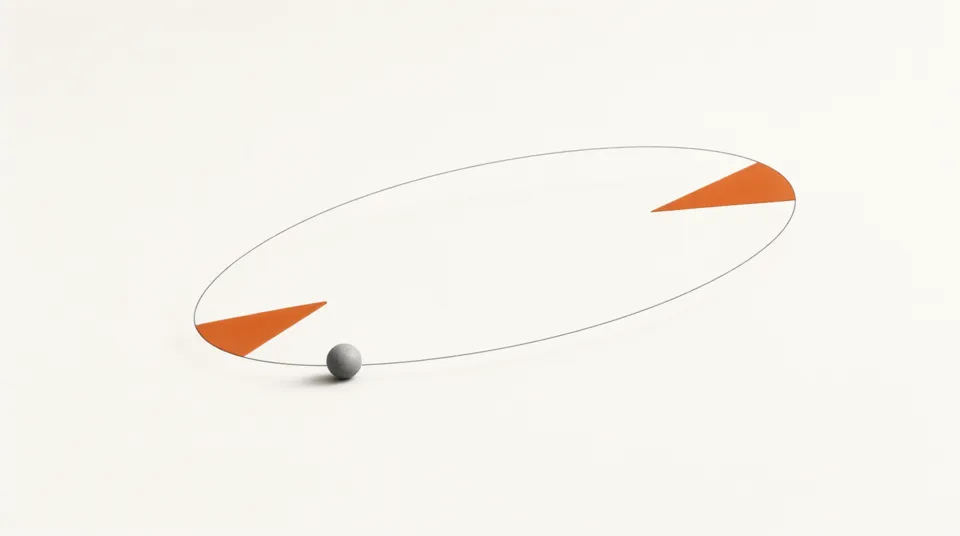
About this experiment
Around 1609 Johannes Kepler worked through years of careful observations of Mars by Tycho Brahe and found three rules that every planet obeys. Orbits are ellipses with the Sun at one focus, a planet sweeps out equal areas in equal times, and the square of the period is proportional to the cube of the orbit size. Change the size and shape of an orbit, watch the planet speed up near the Sun, and check the third law against real planets and a comet.
Learning goals
- State all three of Kepler's laws and illustrate each one
- Describe an ellipse using its semi-major axis, eccentricity and foci
- Explain why a planet moves fastest at perihelion using the equal-areas law
- Use T² = a³ (years, AU) to find the period or the orbit size of a body around the Sun
- Connect the second law to conservation of angular momentum
How to use it
- 1Start with e = 0. What shape is the orbit and where is the Sun? Are all the sectors the same shape?
- 2Raise the eccentricity to 0.6. Watch the speed readout over one orbit. Where is the planet fastest and slowest?
- 3Look at the shaded sectors. They have very different shapes. Compare their areas with the readout.
- 4With foci shown, watch the two grey lines from the foci to the planet. What stays the same as the planet moves?
- 5Pick Mercury, Earth, Mars and Jupiter in turn. Read T and a, and check that T² / a³ stays at 1.
- 6Choose Halley's Comet. How long is its period, and why does it spend most of that time far from the Sun?
- 7Keep e fixed and double a. By what factor does the period grow?
The model
Assumptions
- The planet is much lighter than the Sun, so the Sun stays fixed at the focus. Pulls from other planets are ignored.
- Positions come from solving Kepler's equation exactly at every frame, not from stepping the motion forward.
- Orbit sizes and eccentricities of the real bodies are rounded modern values. Orbits are drawn in their own plane, so tilts are not shown.
- The animation shows every orbit in the same 9 seconds; the readouts give the real times.
Try this in class
- Q1An asteroid orbits at a = 4 AU. What is its period?
- Q2A comet has a period of 125 years. What is its semi-major axis?
- Q3Earth is closest to the Sun in early January. Is Earth moving faster in January or in July? Explain with the second law.
- Q4A comet has perihelion 0.5 AU and aphelion 35 AU. Find a and e.
- Q5Why does the third law in the form T² = a³ not work for the Moon orbiting the Earth?
Frequently asked questions
Why are the sectors so different in shape if they have the same area?
Near the Sun the sector is short and wide because the planet covers a long arc quickly. Far away it is long and thin because the planet moves slowly. The areas come out equal because angular momentum is conserved.
Did Kepler know why his laws worked?
No. He found them from data. About 80 years later Isaac Newton showed that all three follow from an inverse-square law of gravity, which made them strong evidence for his theory.
Is Earth's orbit really an ellipse?
Yes, but a very round one: e = 0.017, so its distance from the Sun only changes by about 3 percent. The seasons are caused by the tilt of the axis, not by this change in distance.