About this experiment
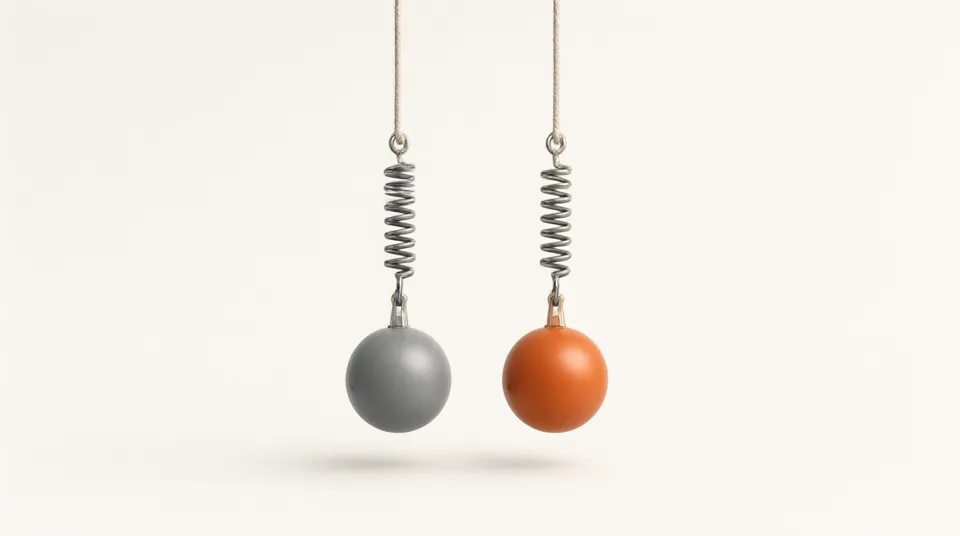
Hang two identical pendulums side by side and join them with a weak spring. Pull only the left one aside and let go: it swings, but slowly its swing dies away while the right pendulum starts to swing, until the right one has all the energy and the left one is almost still. Then the energy flows back. The secret is that the system has two simple ways of moving, called normal modes, and any motion is a mix of both. Try each mode on its own, then change the spring and watch the energy exchange speed up or slow down.
Learning goals
- Describe how energy is transferred back and forth between two coupled oscillators
- Identify the two normal modes: swinging in phase and swinging in opposite directions
- Explain why each normal mode has its own constant frequency
- Relate the time for the energy to move across to the difference of the two mode frequencies (beats)
- Connect coupled oscillators to examples such as molecules, bridges and tuned mass dampers
How to use it
- 1Start with Only the left one and watch for a full minute. How long does it take until the right pendulum has all the energy?
- 2Switch the graph to Energy. What happens to the total of the two energies?
- 3Choose Both the same way. Does the energy move between the pendulums now? Is the spring ever stretched?
- 4Choose Opposite ways. Compare the frequency with the in-phase mode. Why is it higher?
- 5Go back to Only the left one and make the spring stiffer. How does the time for the energy to move across change?
- 6Drag the bobs to make your own starting positions, for example one pulled far and one a little. Can you predict what will happen?
The model
Assumptions
- Small swings, so each pendulum behaves as a simple harmonic oscillator and the sideways displacement is used in place of the angle.
- The two pendulums are identical with a mass of 0.5 kg each. The spring is light and acts along the horizontal line between the bobs.
- Damping, when switched on, slows both modes by the same factor. Without damping the motion goes on for ever.
- The motion is calculated exactly from the two normal modes, not step by step, so it never drifts.
Try this in class
- Q1Why does the in-phase mode have the same frequency as a single pendulum, whatever the spring?
- Q2With a very weak spring, the energy takes a long time to move across. Explain this using the two frequencies.
- Q3Why does the energy return completely to the first pendulum only when both pendulums are identical?
- Q4A tall building has a heavy mass on a spring near the top, called a tuned mass damper. How might it reduce the swaying in a storm?
- Q5A carbon dioxide molecule can vibrate with both oxygen atoms moving the same way or opposite ways. How is this like the two pendulums?
Frequently asked questions
What is a normal mode?
A normal mode is a pattern of motion in which every part moves with the same frequency and keeps the same pattern for ever. Two coupled pendulums have two normal modes. Any other motion is a combination of the two, which is why it looks more complicated.
Why does the energy move between the pendulums?
The two modes have slightly different frequencies, so they slowly drift in and out of step. When they add up at the left bob and cancel at the right bob, the left one swings; half a beat later the opposite happens. This is the same effect as beats between two notes of nearly equal pitch.
Is any energy lost in the spring?
No, the spring only stores energy for a moment and gives it back. Without damping the total energy stays constant; it is just shared differently between the two pendulums and the spring over time.