About this experiment
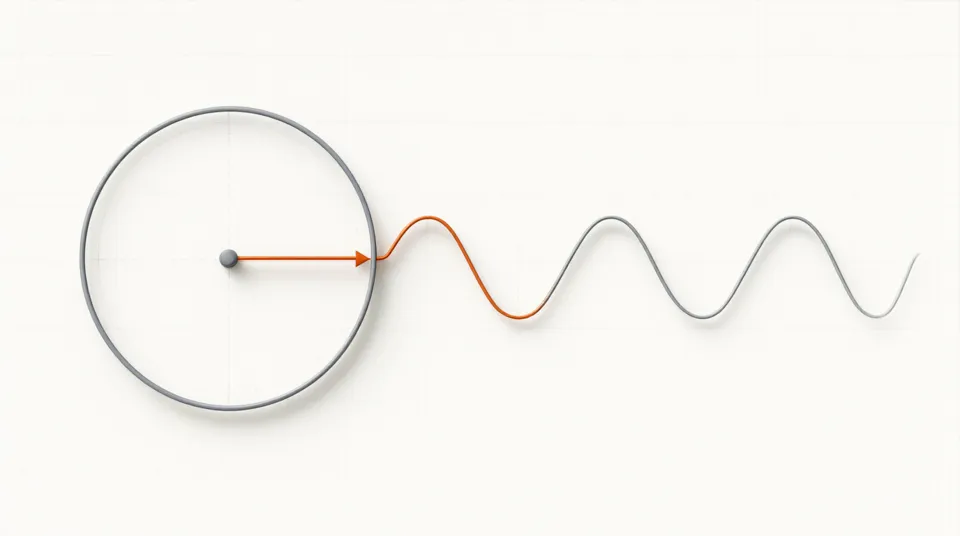
Drag a point around the unit circle and watch its height trace out the sine wave and its horizontal position trace out the cosine wave. The link between the circle and the graph makes the period, the sign in each quadrant and the shape of the tangent curve easy to see. Turn on the transformed curve to explore amplitude, frequency and phase.
Learning goals
- Define sine, cosine and tangent using the unit circle
- Explain why sine and cosine repeat every 2π radians
- Determine the sign of each function in every quadrant
- Describe how A, ω and φ change the graph of y = A sin(ωx + φ)
How to use it
- 1Press Play, or drag the black point around the circle.
- 2Watch the orange segment on the circle and the orange curve grow together for sin θ.
- 3Switch to cos and tan and compare where each one is zero, positive or negative.
- 4Turn on the transformed curve and change A, ω and φ one at a time.
The model
Assumptions
- Angles are measured counterclockwise from the positive x-axis.
- The graph shows one full turn, from 0 to 2π.
Try this in class
- Q1In which quadrants is sin θ positive and cos θ negative?
- Q2Why is tan θ undefined at 90° and 270°? Look at the tangent line.
- Q3Set ω = 2. How many full waves fit between 0 and 2π now?
- Q4Which phase shift turns the sine curve into the cosine curve?
Frequently asked questions
Why use a unit circle?
With radius 1, the x and y coordinates of the point are exactly cos θ and sin θ, so the definitions work for every angle, not only for angles in a right triangle.
What is a radian?
It is the angle that cuts an arc equal in length to the radius. A full turn is 2π radians, which equals 360°.
Why does the tangent graph have breaks?
At 90° and 270° the point is on the y-axis, so x = 0 and y/x has no value. The graph shoots off toward infinity there.