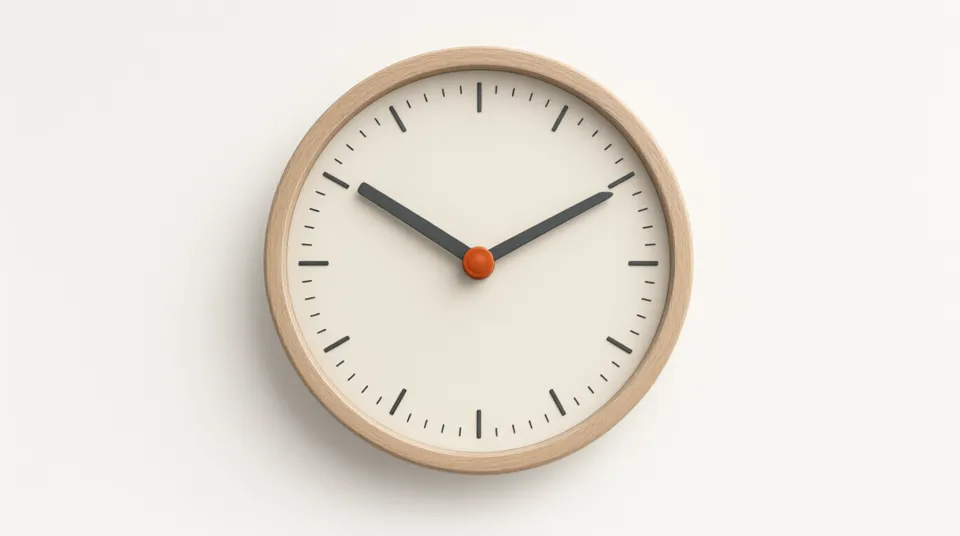
About this experiment
A clock face has two hands that work together. The long minute hand goes once round the clock every hour, and the short hour hand moves slowly from one number to the next in the same time. Drag the hands and watch the digital time and the words change, let time run fast to see how the hour hand creeps along, then switch to Set the clock and try to show the times you are given.
Learning goals
- Read and show times to the hour, half hour and quarter hour on an analogue clock
- Read times to five minutes and to the nearest minute
- Say times using past and to
- Match analogue times with 12-hour and 24-hour digital times
- Explain why the hour hand is between two numbers when it is not exactly on the hour
How to use it
- 1Drag the long hand all the way round once. What happens to the short hand?
- 2Make 3 o'clock, half past 3 and quarter to 4. Where is the short hand each time?
- 3Turn on the minute numbers and count round in fives. How many minutes past the hour is the 4?
- 4Press Let time pass and stop it at a time of your choice. Say the time in words, then check.
- 5Switch on 24-hour digital time and make 3 in the afternoon. What does the digital clock show?
- 6Choose Set the clock and answer five questions at your level. Then try the next level.
The model
Assumptions
- The clock is a normal 12-hour clock. Morning and afternoon are shown with am and pm and with the sun or the moon.
- After half past, the time is said as minutes to the next hour, as in English. In some languages people also say times differently, for example 9:45 as nine forty-five.
- Questions in Set the clock come from a fixed list for each set, so the whole class can work through the same questions.
Try this in class
- Q1At half past 6, why is the short hand halfway between 6 and 7 and not on the 6?
- Q2Which is later, quarter to 5 or quarter past 4? How many minutes apart are they?
- Q3School starts at 8:45 and the first lesson lasts 50 minutes. What time does it end?
- Q4How many times does the minute hand go round the clock between breakfast at 7 am and lunch at 12 noon?
- Q5A bus timetable says 17:20. What is that in words, and is it morning or afternoon?
Frequently asked questions
Why does the clock only show 12 hours when a day has 24?
The hour hand goes round twice every day: once from midnight to midday and once from midday to midnight. That is why we add am or pm, or use the 24-hour clock, to say which half of the day we mean.
How can children tell the hour and minute hands apart?
The minute hand is long and points to the minutes round the edge. The hour hand is short and points to the hour numbers. In this lab the minute hand is orange to make it easier to see.
When should children start using minutes to the hour?
Most curricula start with o'clock and half past, then quarter past and quarter to, then five-minute steps and finally single minutes. The levels in Set the clock follow the same order.