About this experiment
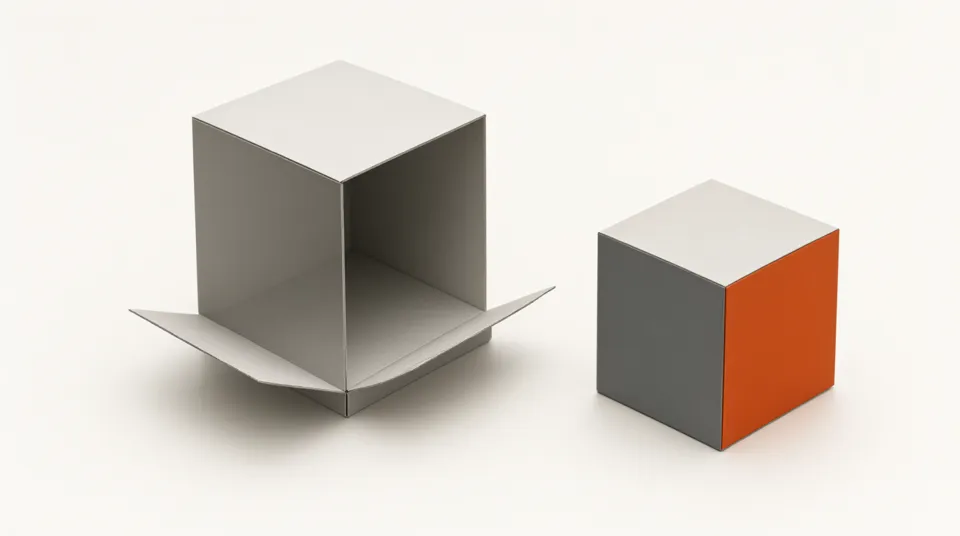
A net is a flat shape that folds up into a 3D solid, like a cereal box opened out flat. Pick a net of a cube, a triangular prism, a square pyramid or a tetrahedron and fold it on the table, all at once or one face at a time. Turn the scene to watch every edge meet its partner. One of the nets looks like it should make a cube but does not: fold it and see what goes wrong.
Learning goals
- Recognise nets of cubes, prisms and pyramids
- Predict whether a pattern of six squares folds into a cube
- Count the faces, edges and vertices of a solid and check that F + V - E = 2
- Find the surface area of a solid from the area of its net
- Relate the volume of a solid to its edge length
How to use it
- 1Choose Cube: cross net and press Fold. Which face ends up on top?
- 2Fold it again with Fold one face at a time switched on. Notice that a face can only fold after the face it is attached to.
- 3Choose Cube: staircase net. Before folding, predict which squares will become opposite faces. Fold to check.
- 4Choose Is this a cube net? and predict the answer. Fold it fully and look at which faces turn orange.
- 5Fold the prism, the pyramid and the tetrahedron. For each one record F, V and E and work out F + V - E.
- 6Set the edge length to 3 cm. Check the surface area of the cube by adding up the squares of the net.
The model
Assumptions
- Every face is a regular polygon: the prism has equilateral triangle ends and rectangular sides 1.5 times as long as the base edge, and the pyramid and tetrahedron have equilateral triangle faces.
- Faces are rigid and have no thickness, and the hinges are along shared edges of the net.
- Each face folds through 180° minus the angle between neighbouring faces of the finished solid: 90° for a cube, about 109.5° for a tetrahedron and about 125.3° for the pyramid.
Try this in class
- Q1There are 11 different nets of a cube. Sketch three that are not shown here.
- Q2Why can a net of a cube never have four squares in a row with both extra squares on the same side?
- Q3A dice has opposite faces that add up to 7. Number the cross net so that it folds into a proper dice.
- Q4How many faces, edges and vertices does a hexagonal prism have? Does Euler’s formula still work?
- Q5If you double the edge length of a cube, what happens to its surface area and to its volume?
Frequently asked questions
How can I tell if six squares make a net of a cube?
Look for rows of four: if there is one, the other two squares must be on opposite sides of it. Also, a net of a cube never contains a 2 × 2 block of squares. When in doubt, fold it in your head one face at a time.
Why does the pyramid fold more than 90°?
The triangles have to lean in until their tips meet above the middle of the base. With equilateral triangles that happens when each triangle has turned about 125° from the flat net.
Do the nets in packaging work the same way?
Yes, with one extra detail: real boxes have small flaps (tabs) along some edges so the faces can be glued or tucked in.