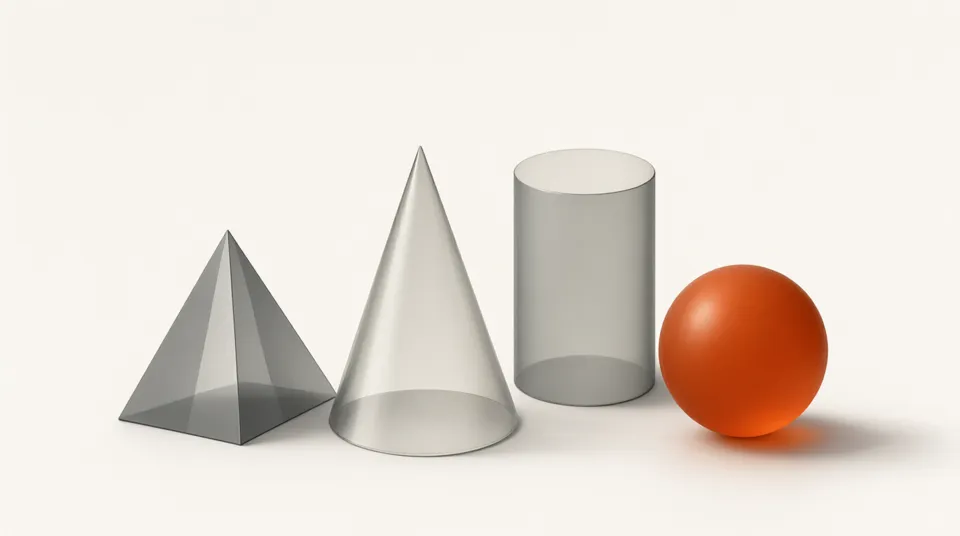
About this experiment
Measure a solid with a sliding section plane. Compare cross-sectional area, volume accumulated below the plane and the matching prism or cylinder that bounds the solid.
Learning goals
- Connect dimensions with exact volume and surface-area formulas.
- Relate cross-sectional area to accumulated volume.
- Compare cone, pyramid and sphere volumes with their matching reference solids.
How to use it
- 1Move the section from the base to the apex of a square pyramid.
- 2Compare the area at half height with the base area.
- 3Inspect the accumulated volume below half height, which is not half the total volume.
- 4Switch to a sphere and compare it with the matching cylinder.
The model
Assumptions
- The cone is right circular and the pyramid is right with a square base. All lengths use arbitrary coordinate units.
- Sections are horizontal and parallel to the base. Sphere sections are measured upward from the bottom point.
- The transparent reference is the uncut bounding prism or cylinder. At a point-like section the area is zero.
Try this in class
- Q1Why does halving the height of a cone section leave one quarter of the base area?
- Q2Why does a sphere occupy two thirds of its matching cylinder?
Frequently asked questions
Is the area profile a numerical approximation?
The section and accumulated-volume readouts use analytic formulas. The plotted curve is a sampled rendering of those formulas.
Does changing the camera alter measured surface area?
No. Camera motion changes perspective only; areas use the underlying dimensions.