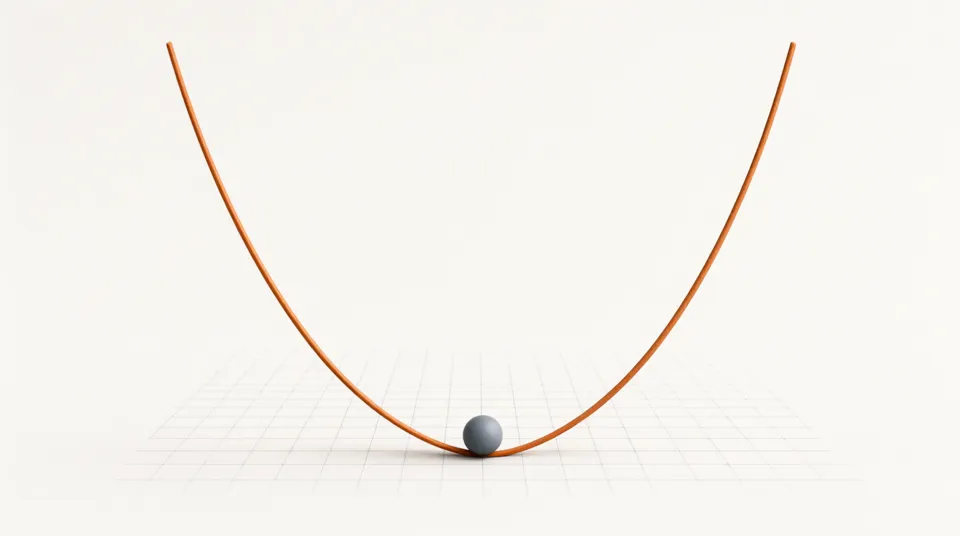
About this experiment
Change a, b and c and watch the parabola respond instantly. The vertex, the axis of symmetry, the roots and the y-intercept are marked and updated as you move the sliders. Switch to vertex form to slide the parabola around by its turning point, or drag the vertex directly on the graph.
Learning goals
- Describe how a changes the width and direction of a parabola
- Find the vertex and axis of symmetry from the standard form
- Use the discriminant to predict the number of real roots
- Convert between standard form and vertex form
How to use it
- 1Move the a slider through zero and watch the parabola flip from opening up to opening down.
- 2Change b on its own. Notice that the vertex moves along a curve while the y-intercept stays fixed.
- 3Switch to vertex form and change h and k to translate the graph.
- 4Find values where Δ is zero and check that the parabola just touches the x-axis.
The model
Assumptions
- All values are exact. Readouts are rounded to two decimal places.
- Only real roots are shown. When Δ < 0 the roots are complex and the graph does not cross the x-axis.
Try this in class
- Q1Which parameter decides whether the parabola opens upward or downward?
- Q2Keep a and c fixed and change b. Which point on the graph never moves?
- Q3Find a parabola with vertex (2, -1) that passes through the origin.
- Q4How does the sign of Δ relate to the number of x-intercepts?
Frequently asked questions
What does a do to the graph?
Its sign sets the direction of opening and its size sets the width. A larger |a| makes a narrower parabola.
Why is the vertex at x = -b/2a?
The parabola is symmetric, so the vertex lies halfway between the two roots, and the average of the roots from the quadratic formula is -b/2a.
Can I enter exact values?
The sliders move in steps of 0.1 or 0.5, which covers most textbook exercises. Dragging the vertex snaps to steps of 0.1.