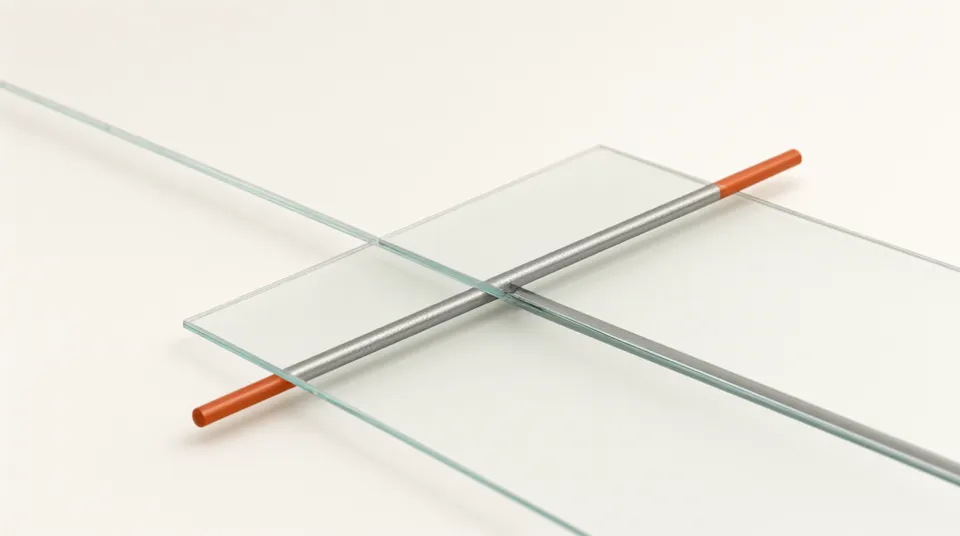
About this experiment
Position two spatial objects and measure their smaller angle, intersections or nearest points. Compare parallel, coincident, intersecting and skew cases without confusing the finite drawing with an infinite mathematical line or plane.
Learning goals
- Distinguish line directions from plane normals.
- Compute smaller angles and shortest distances in space.
- Recognise skew lines and invalid zero directions.
How to use it
- 1Start with a line crossing a plane and inspect the intersection coordinates.
- 2Change the line direction until it is parallel to the plane.
- 3Compare two planes using their normals.
- 4Construct skew lines and inspect the shortest connecting segment.
The model
Assumptions
- All lines and planes are infinite in the model. Their displayed patches and highlighted intersections are cropped to a finite view.
- A zero direction or normal is invalid and returns undefined measurements instead of an invented geometry.
- Plane-plane and line-line angles are the smaller nonnegative angles. Numerical comparisons use a small floating-point tolerance.
Try this in class
- Q1Why does rotating a plane normal by 180 degrees leave the same plane?
- Q2How can two nonparallel spatial lines still fail to intersect?
Frequently asked questions
Why can an intersection disappear from the drawing while its coordinates remain available?
The exact intersection can lie beyond the finite camera window, especially for nearly parallel objects.
What distinguishes parallel from coincident objects?
Coincident objects have the same complete point set. Parallel distinct objects retain a nonzero perpendicular separation.