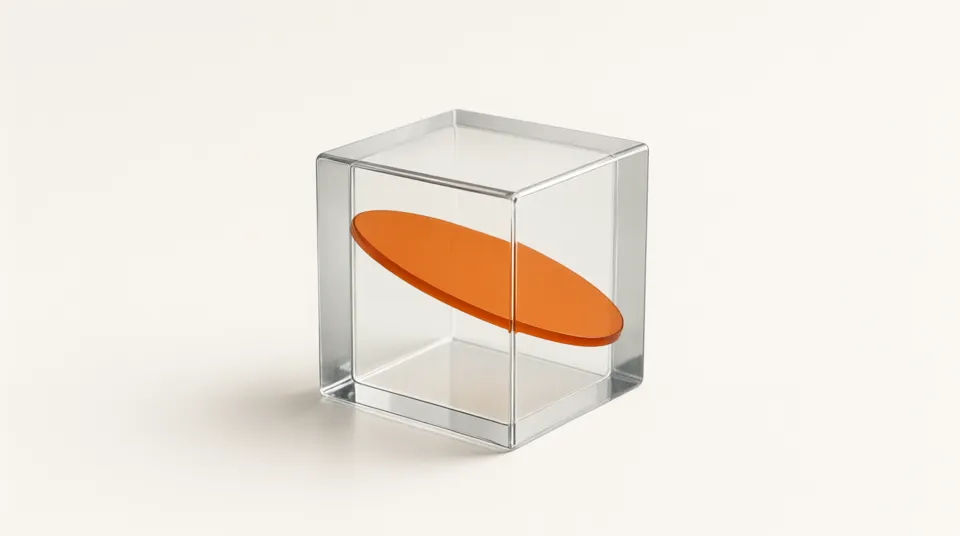
About this experiment
Slide and rotate an infinite cutting plane through a cube. Measure triangles, quadrilaterals, pentagons and hexagons, and inspect degenerate cuts that touch only an edge or vertex.
Learning goals
- Relate plane orientation and position to a section polygon.
- Calculate section area and perimeter in the plane itself.
- Distinguish an interior polygon from a tangent segment, point or empty intersection.
How to use it
- 1Inspect the regular hexagonal central section and select its vertices.
- 2Move the plane toward a corner until the section becomes a triangle.
- 3Rotate the normal to obtain a face-parallel square.
- 4Move outside the support distance and explain why no section remains.
The model
Assumptions
- The cube is closed and the mathematical plane is infinite. The visible plane is a finite drawing patch.
- Intersections within a small coordinate tolerance are merged, so a plane through a cube vertex does not create duplicate section vertices.
- A segment or point has zero polygon area and no polygon perimeter. A plane coincident with a cube face has that full face as its intersection.
Try this in class
- Q1Why can a section of a cube have six sides although each face has four?
- Q2How do area and perimeter change when every cube length is doubled?
Frequently asked questions
Is a triangular section necessarily a face of the cube?
No. It can lie obliquely across three adjacent cube edges near a corner.
Can the largest visible polygon be read accurately from its perspective drawing?
Use the area readout. Perspective foreshortening changes apparent area on screen but not the computed in-plane area.