About this experiment
Slice a double cone with a flat plane and you get a circle, an ellipse, a parabola or a hyperbola. The same four curves appear in planetary orbits, satellite dishes, car headlights and the paths of comets. One number ties them together: the eccentricity e. Every point on the curve is e times as far from a fixed point, the focus, as from a fixed line, the directrix. Slide e from 0 to 2, move a point round the curve, and check the distances.
Learning goals
- Define a conic section using a focus, a directrix and the eccentricity
- Classify a conic as a circle, ellipse, parabola or hyperbola from its eccentricity
- Use the two-focus property of the ellipse and hyperbola
- Write the equation of a conic in standard form and find a, b and c
- Relate each conic to the angle at which a plane cuts a cone
How to use it
- 1Press Move P round the curve with the ellipse. Watch PF ÷ PD. Does it ever change?
- 2Look at PF + PF′. Why is this the same everywhere on the ellipse? Compare it with 2a.
- 3Slowly increase e towards 1. What happens to the far end of the ellipse? Where is the second focus?
- 4Set e = 1. Check that every point is as far from the focus as from the directrix.
- 5Increase e above 1. How many branches does the curve have? Check |PF - PF′|.
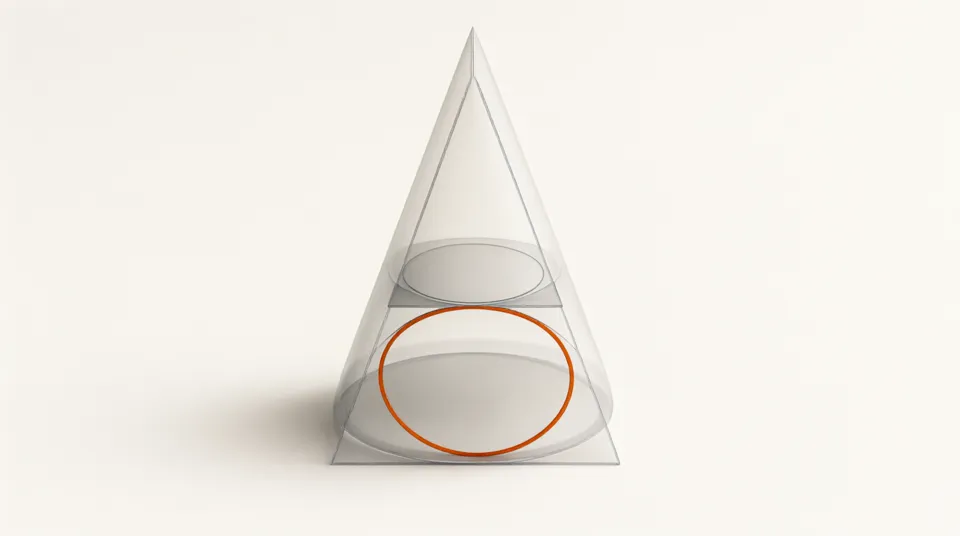
- 6Watch the cone picture as you change e. How is the angle of the plane linked to the shape?
The model
Assumptions
- The focus F is at the origin and the directrix is the line x = -p. The equation shown is shifted so its centre or vertex is where it really lies on the grid.
- e = 0 is treated as a circle of radius p round the focus; strictly, a circle is the limit where the directrix moves off to infinity.
- The cone in the picture has a half-angle of 60°, so a plane at angle β to its axis gives e = cos β / cos 60°.
- For a hyperbola, the paler branch belongs to the other focus. P moves only on the branch round F.
Try this in class
- Q1An ellipse has a = 5 and b = 3. Find c and the eccentricity.
- Q2The Earth orbits the Sun with e = 0.017 and Halley's comet with e = 0.967. Describe the two orbits.
- Q3Why are satellite dishes and headlight reflectors made in the shape of a parabola?
- Q4Find the equation of the parabola with focus (0, 0) and directrix x = -2.
- Q5A plane cuts a cone parallel to one of its sides. Which conic does it make, and why?
Frequently asked questions
Why is it called eccentricity?
It measures how far the curve is from being centred on its focus. A circle, with e = 0, has its focus at the centre. As e grows, the focus moves off-centre and the curve stretches out, until at e = 1 it no longer closes.
What is the second focus for?
An ellipse and a hyperbola each have two foci. For an ellipse the two distances to the foci always add up to 2a, which is how gardeners draw an elliptical bed with two pegs and a loop of string. For a hyperbola their difference is always 2a.
Where do conics appear in physics?
Anything moving under an inverse-square force follows a conic with the attracting body at a focus: planets on ellipses, a spacecraft escaping on a parabola or hyperbola, and alpha particles scattering off a nucleus on hyperbolas.