About this experiment
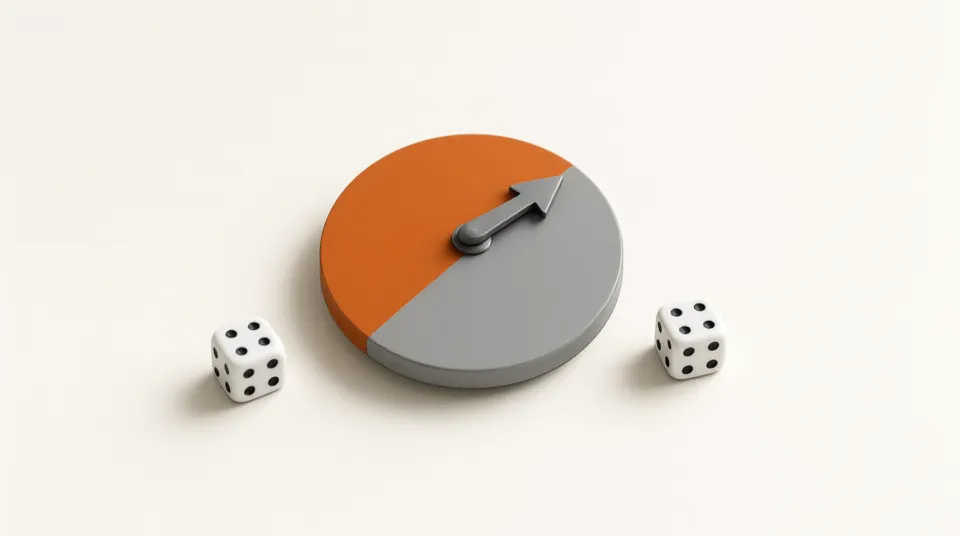
Will the spinner land on red? If every section is red it is certain; if there is no red at all it is impossible. In between, the more red sections there are, the more likely red becomes. Build your own spinner, place each colour on the line from impossible to certain, then spin it again and again and see whether the results match what you expected.
Learning goals
- Use the words impossible, unlikely, even chance, likely and certain to describe events
- Place events on a likelihood line from impossible to certain
- Explain that a spinner with more sections of a colour is more likely to land on it
- Describe a chance as a number of sections out of the total, such as 1 out of 4
- Notice that results of a few spins can be surprising, but many spins come closer to what we expect
How to use it
- 1Choose All red. Where does red go on the likelihood line? Spin to check.
- 2Choose No red. Can the spinner ever land on red?
- 3Choose Half red. What word describes landing on red? Spin 10 times. Did you get exactly 5 reds?
- 4Now spin 100 times. Is the red bar closer to the dashed line?
- 5Build a spinner where blue is likely but not certain. Ask a partner to check it.
- 6Build a spinner where all four colours have an even chance with each other. How many sections of each do you need?
The model
Assumptions
- All sections are the same size and the spinner is fair, so it is equally likely to stop at any point.
- The spins follow a fixed random sequence, so the whole class sees the same results after pressing Reset.
- Even chance is used only for exactly half. Anything less than half is unlikely and anything more is likely.
Try this in class
- Q1A spinner has 3 red and 1 blue section. Which colour is more likely? Explain why.
- Q2Describe something that is certain to happen tomorrow and something that is impossible.
- Q3Sam spins a half red spinner 4 times and gets red every time. Is the spinner unfair? Why might this happen?
- Q4How could you make a spinner where yellow is unlikely but not impossible?
- Q5Why is it hard to tell if a spinner is fair from just a few spins?
Frequently asked questions
Why do 10 spins not give exactly what we expect?
Each spin is a matter of chance, so a few spins can easily come out uneven. With 100 or 1000 spins the share of each colour usually gets closer to its chance, but it is still rarely exact.
What does even chance mean?
Something is just as likely to happen as not to happen, like a coin landing on heads. On a spinner, half of the sections are that colour.
How can I use this with the class?
Ask pupils to predict before each spin, to describe each spinner with a likelihood word, and to design spinners that match a description. Making paper spinners with a pencil and paper clip works well alongside it.