About this experiment
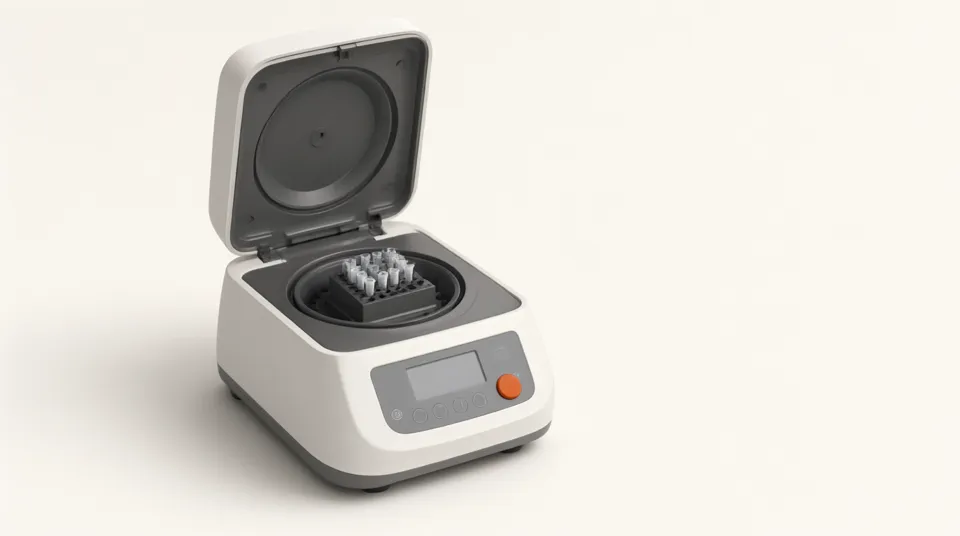
The polymerase chain reaction copies one stretch of DNA billions of times in an afternoon. A thermocycler repeats three steps: heat to separate the strands, cool so primers can stick, warm so a heat-stable polymerase builds the new strands. Each cycle can double the target. Run the program step by step, change the annealing temperature and extension time, and read the threshold cycle the way a real-time PCR machine does.
Learning goals
- Describe what happens to the DNA in the denaturation, annealing and extension steps
- Explain why primers and a heat-stable polymerase are needed
- Calculate the number of copies after n cycles of ideal doubling
- Explain why amplification slows down and reaches a plateau
- Use the threshold cycle Ct to compare how much template different samples contained
How to use it
- 1Run the first cycle slowly. Pause in each step and describe what the strands, primers and polymerase are doing.
- 2Use the readouts for one template to find after which cycle the first molecules of exactly the target length appear.
- 3Run all 40 cycles with the log plot. Why is the early part a straight line? Then switch to the fluorescence plot and describe its shape.
- 4Note Ct, then change the starting copies by a factor of 10. How much does Ct change? Explain the number.
- 5Raise the annealing temperature above the primer Tm. What happens to the efficiency and the product?
- 6Lower the annealing temperature to 48 °C and look at the gel. What is the extra band and why does it appear?
- 7Shorten the extension time to 10 s. Why does less product form?
The model
Assumptions
- Efficiency is 95 % per cycle at a good annealing temperature. It falls smoothly when annealing is hotter than about Tm + 2 °C because fewer primers stay bound.
- The 500 bp product needs about 30 s of extension at about 1000 bases per minute. Shorter extension copies proportionally fewer strands to the end.
- Annealing far below Tm lets primers bind at wrong sites and make a shorter off-target product that competes for the same reagents. Its size and the onset temperature are illustrative.
- The plateau at 10^12 copies and the detection threshold at 10^10 copies are typical orders of magnitude for a 25 µL reaction with SYBR Green, not exact values.
- The counts for one template assume perfect doubling and show which molecules have exactly the target length; the rest are longer strands copied from the original template.
Try this in class
- Q1How many copies does a single template give after 30 ideal cycles?
- Q2Sample A has Ct = 22 and sample B has Ct = 25. Roughly how many times more template did sample A contain?
- Q3Why must the polymerase come from a bacterium that lives in hot springs?
- Q4Why do the primers have to bind to opposite strands and point towards each other?
- Q5Suggest why a forensic laboratory can produce a DNA profile from a single hair root.
Frequently asked questions
Why does the curve flatten at the end?
Primers and nucleotides get used up, the polymerase loses activity after many heat cycles, and newly made strands increasingly pair with each other instead of with primers. All of these slow copying, so the product stops doubling.
What does Ct tell a diagnostic lab?
Ct is the cycle at which the fluorescence crosses a set threshold. A sample with more starting template crosses earlier. Comparing Ct with a dilution series gives the starting amount, which is how viral load tests and gene expression measurements work.
Who invented PCR?
Kary Mullis described the method in 1983 and shared the 1993 Nobel Prize in Chemistry for it. The use of Taq polymerase from Thermus aquaticus, which survives the 95 °C step, made it practical to automate.