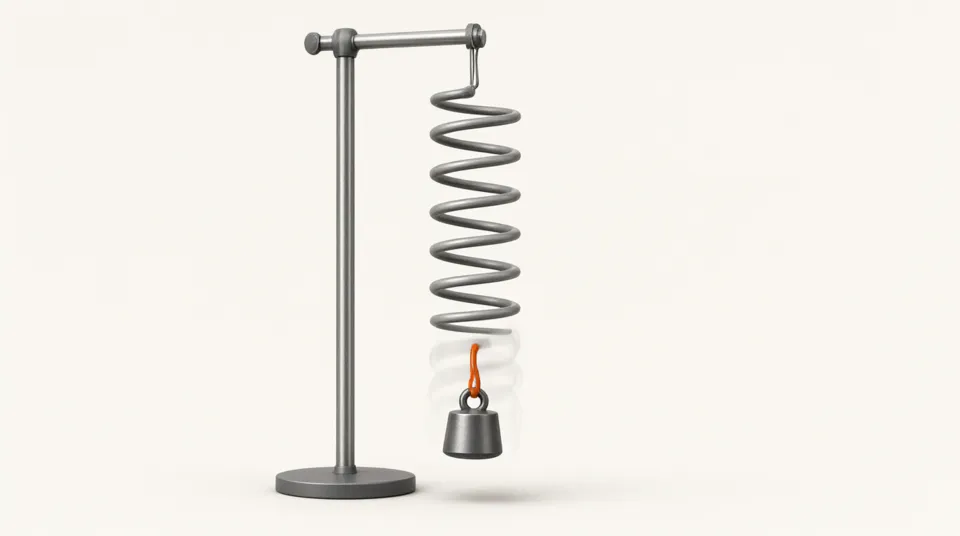
About this experiment
Release a mass from an extended horizontal spring and follow its position, velocity and mechanical energy. Change the damping to compare repeated oscillations, the fastest non-oscillating return, and a slow overdamped return. The moving mass and the time graph use the same analytic solution, so pausing or scrubbing gives the same state every time.
Learning goals
- Relate mass and stiffness to the natural frequency of a spring oscillator
- Distinguish underdamped, critically damped and overdamped motion
- Explain mechanical energy loss under a velocity-proportional drag force
- Read period, amplitude and decay from a displacement-time graph
- Explain where damped oscillators appear in real life, from car suspensions to measuring instruments
How to use it
- 1Start with the default settings and press Play. Pause near the first equilibrium crossing and compare position, speed and energy.
- 2Set damping to zero and compare the mechanical energy at several times.
- 3Choose Critical damping and compare the return with a larger damping coefficient.
- 4Keep stiffness fixed, increase mass and compare the oscillation period after resetting time.
- 5Set damping to about half the critical value and count how many swings it takes for the amplitude to halve.
The model
Assumptions
- The spring is massless and linear, and the mass moves horizontally without dry friction.
- Damping is a force opposite velocity with a constant coefficient b. There is no external drive.
- Every run starts from the selected displacement with zero velocity. Changing a model parameter restarts time.
- All damping regimes use analytic solutions. The drawing is a schematic view of the same displacement, not a separate numerical physics engine.
Try this in class
- Q1Why is speed largest near equilibrium for an undamped oscillator?
- Q2Does stronger damping always return the mass to equilibrium sooner? Compare critical and heavy damping.
- Q3What happens to the natural period when mass is multiplied by four?
- Q4Car shock absorbers are designed to be close to critically damped. What would the ride feel like if they were strongly underdamped?
- Q5Two springs have the same mass attached, but one is four times stiffer. How do their periods compare?
Frequently asked questions
Does mechanical energy stay constant?
It stays constant when b is zero. With positive damping, energy is converted to untracked thermal energy at rate b times velocity squared; the displayed mechanical energy decreases.
Why is no period shown for critical or overdamped motion?
Those regimes return without repeating oscillations, so an oscillation period is not defined.
Does the amplitude change the period?
Not for an ideal linear spring. The period depends only on mass, stiffness and damping, which is why spring and pendulum clocks keep good time even as their swing slowly shrinks.