About this experiment
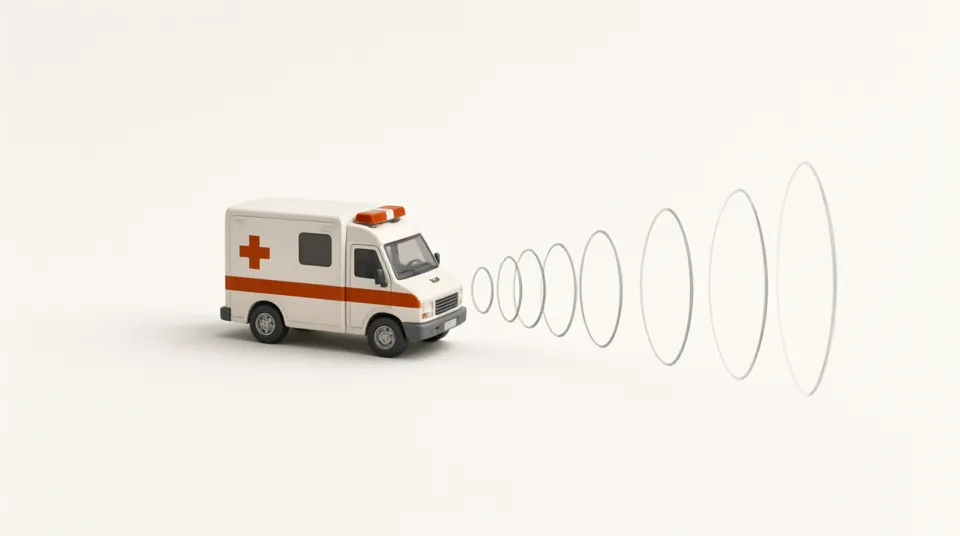
When an ambulance races past, its siren drops in pitch. This is the Doppler effect. Each wave crest leaves the source from a slightly different place, so the crests bunch up in front of a moving source and spread out behind it. Watch the circular wavefronts, drag a listener anywhere around the road, and switch on the sound to hear the pitch the listener hears. Push the source past the speed of sound and the wavefronts pile up into a shock wave.
Learning goals
- Explain the Doppler effect in terms of wavefronts emitted from different positions
- Calculate the observed frequency in front of and behind a moving source
- Describe how the heard frequency changes as a source passes a listener at the side of the road
- Explain the Mach cone and the sonic boom when the source moves faster than sound
How to use it
- 1Set the source speed to At rest and press Play. Describe the pattern of wavefronts.
- 2Choose Racing car and play again. Compare the spacing of the wavefronts in front of and behind the source.
- 3Move the listener close to the road and switch on Hear the listener. Play and listen to the pitch as the car passes.
- 4Now drag the listener far from the road and play again. Compare the shape of the frequency graph: why is the drop smoother?
- 5Use the readouts to check the formula for straight ahead and straight behind at 120 m/s and 220 Hz.
- 6Choose Speed of sound and then Supersonic. Where do the wavefronts pile up, and when does the listener first hear anything?
The model
Assumptions
- The air is still and the listener does not move, so only the source motion matters.
- The speed of sound is fixed at 343 m/s, its value in dry air at 20 °C.
- Time is slowed down so the waves can be seen. The frequencies and the pitch you hear are the real values.
- The source starts emitting at t = 0, so the listener hears nothing until the first wavefront arrives.
Try this in class
- Q1A train sounds its horn at 400 Hz while approaching at 40 m/s. What frequency does a person on the platform hear?
- Q2Why does the pitch of a passing car drop suddenly if you stand by the road but gradually if you stand far away?
- Q3Does the loudness or the pitch tell you that a car is coming towards you?
- Q4Why do you hear a sonic boom from a supersonic aircraft only after it has passed overhead?
- Q5Doctors use the Doppler effect in ultrasound scans of blood flow. What do they measure?
Frequently asked questions
Does the source frequency actually change?
No. The source vibrates at the same frequency all the time. The listener receives the crests more or less often because the distance the sound has to travel keeps changing.
Why does the frequency change smoothly rather than in one jump?
Only a listener exactly on the path of the source hears a jump from the high to the low value. Anywhere else the angle to the source changes gradually, so the frequency slides from high to low as the source passes.
What happens exactly at the speed of sound?
All the wavefronts in front of the source pile up at the source itself. The formula for straight ahead gives an infinite frequency, which is the sign of a shock wave.
Is this the same effect as the redshift of galaxies?
It is related. Light from galaxies moving away from us is shifted to longer wavelengths. For light, though, the exact formula comes from relativity and on large scales the shift is mainly caused by the expansion of space.