About this experiment
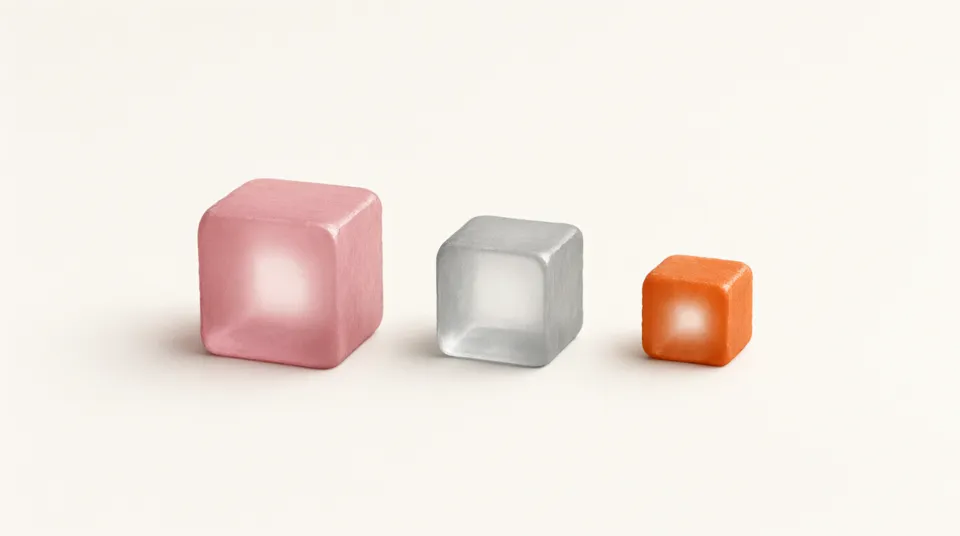
Why are cells so small, and why is an elephant not just one giant cell? Everything a cell needs, such as oxygen and glucose, has to come in through its surface, but the amount it needs depends on its volume. As a cell grows, its volume grows faster than its surface. Soak agar cubes of different sizes in acid and watch the pink colour vanish from the outside in, then change the size and shape of a cell to see when its surface can no longer keep up.
Learning goals
- Calculate the surface area, volume and surface area to volume ratio of a cube
- Explain why the surface area to volume ratio falls as an object gets bigger
- Explain why diffusion alone can only supply small cells and organisms
- Describe how flattened and long thin shapes increase the surface area to volume ratio
- Link these ideas to adaptations such as villi, alveoli, root hairs and red blood cells
How to use it
- 1Start the agar cubes. Which cube loses its pink colour completely first? Read the times.
- 2Compare the tables. The 3 cm cube has 27 times the volume of the 1 cm cube. How many times the surface area does it have?
- 3Pause at 8 minutes and read the share of each cube the acid has reached. Explain the pattern using the surface area to volume ratio.
- 4The 2 cm cube is twice as wide as the 1 cm cube. How many times longer does it take to clear?
- 5Switch to Cell shapes. Make the sphere bigger until it runs short. How large can it get?
- 6Keep the same volume and try the flat disc and the long rod. Which shapes let a big cell still get enough?
The model
Assumptions
- Acid diffuses into the agar with an effective diffusion coefficient of 1.0 × 10⁻⁸ m²/s, chosen so a 1 cm cube clears in about 8 minutes as in a typical class experiment.
- The indicator changes colour where the acid reaches half of its outside concentration. The acid outside the cube stays at the same strength.
- In the cell model, oxygen enters at the same rate through every square micrometre of membrane and every cubic micrometre uses it at the same rate.
- The flat disc is one fifth as thick as it is wide; the rod is ten times as long as it is wide.
Try this in class
- Q1Find the surface area to volume ratio of cubes with sides 1 cm, 2 cm and 4 cm. Describe the pattern.
- Q2A 1 cm cube clears in 8 minutes. Estimate how long a 4 cm cube would take, and explain your reasoning.
- Q3Why do large animals need lungs, gills and a circulatory system, while a single-celled amoeba does not?
- Q4Red blood cells are flattened discs. How does this shape help them do their job?
- Q5Why do elephants have such large, thin ears?
Frequently asked questions
How do I run the real experiment?
Make agar with a little sodium hydroxide and phenolphthalein so it sets pink. Cut cubes of 1, 2 and 3 cm, place them in dilute hydrochloric acid, and time how long each takes to turn colourless. Wear eye protection.
Why does doubling the size make the time four times longer?
Diffusion spreads out like a random walk. To travel twice as far, a molecule needs about four times as long, because the distance covered grows with the square root of the time.
Do all cells have the same size limit?
No. The limit depends on how fast the cell uses materials and how fast they can cross the membrane. Some cells, like nerve cells and egg cells, are huge because they are long and thin, or because they store food and use little oxygen.