About this experiment
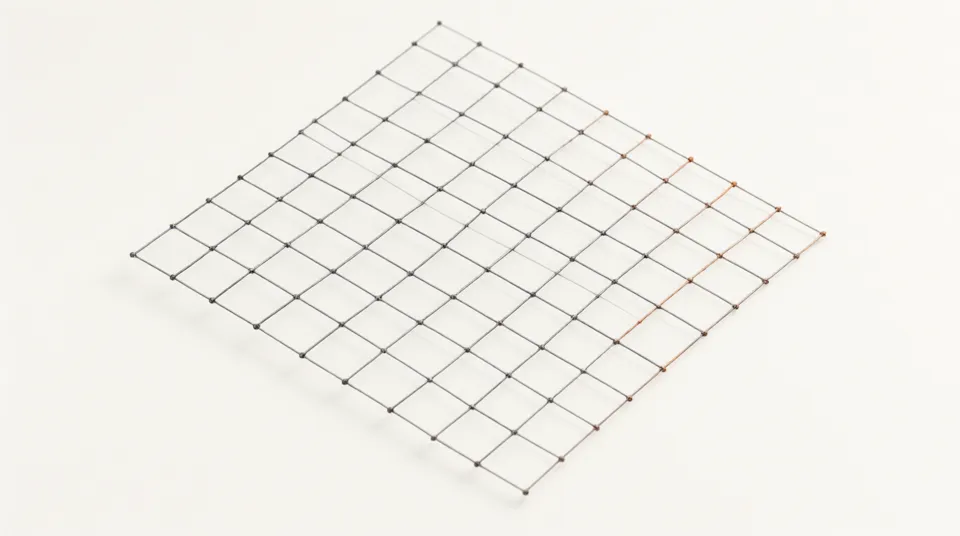
Transform a coordinate grid, a unit square and a selected input vector with a 2 by 2 matrix. Change the entries to make stretches, shears, reflections and collapses. Replay the transformation to inspect intermediate linear maps, or drag the input vector and compare its image. Both axes use the same scale so geometry remains meaningful.
Learning goals
- Interpret matrix columns as the images of the coordinate basis vectors
- Connect determinant magnitude with the area scale factor
- Identify orientation reversal and singular transformations
- Build matrices for rotations, reflections, stretches and shears
- Use the determinant to decide whether a matrix has an inverse
How to use it
- 1Change b while leaving a and d at 1 and c at 0. Observe a horizontal shear and its area factor.
- 2Choose Rotate 90 degrees and compare the input vector with the final transformed vector.
- 3Choose Reflect and inspect the determinant sign and the orientation of the unit square.
- 4Choose Collapse, then scrub transformation progress. Notice when the square loses its area.
- 5Read the first column of the matrix and find the point where the vector (1, 0) lands. Repeat for the second column and (0, 1).
- 6Make a stretch by setting a = 2 and d = 0.5 with b = c = 0. Check that the area factor is 1.
The model
Assumptions
- The mapping is linear and fixes the origin. There is no translation term.
- The original and transformed grids are drawn with equal horizontal and vertical scale. Grid lines can be clipped at the viewport edge.
- Playback interpolates matrix entries, not a physical rigid rotation. Intermediate maps can shrink, distort or collapse a shape even when the final matrix is a rotation.
- The highlighted square has unit area before transformation. Dragging the input vector does not change the matrix.
Try this in class
- Q1Why does a shear with matrix [1, b; 0, 1] preserve area?
- Q2How can two different input vectors acquire the same image under a singular matrix?
- Q3Why can interpolating from identity to a reflection pass through a zero determinant?
- Q4Which matrix rotates the plane by 180°? What is its determinant?
- Q5If the determinant is 0, can you undo the transformation? Why not?
Frequently asked questions
Why can the square shrink during the rotation preset animation?
Only the final matrix is the selected rotation. The animation follows a straight line between matrix entries, so intermediate matrices generally are not rotations.
What does a negative determinant mean?
Its magnitude still gives the area factor. Its negative sign means orientation is reversed, as with a reflection. A determinant of zero collapses area into a line or point.
Why are the columns of the matrix so important?
The first column is where (1, 0) goes and the second is where (0, 1) goes. Every other vector is a combination of those two, so the columns completely describe the transformation.