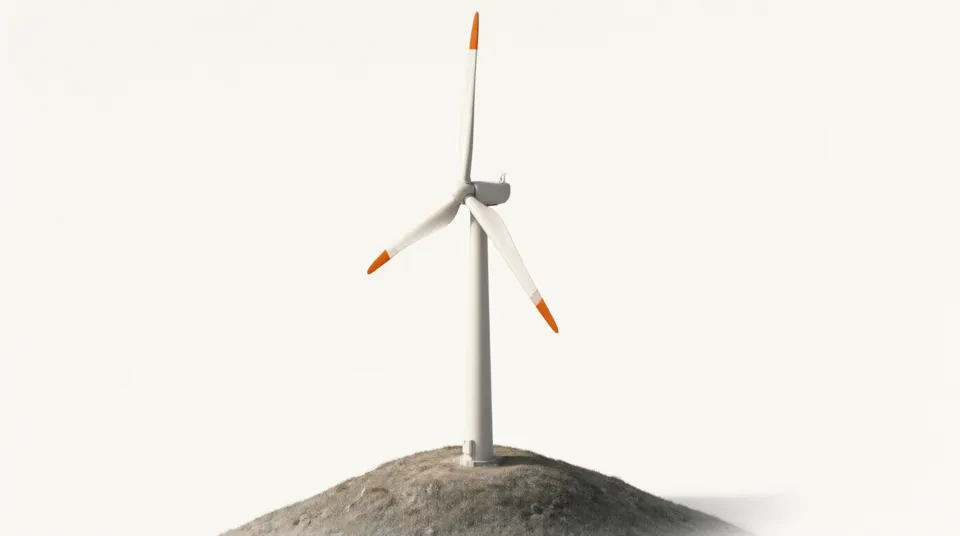
About this experiment
A modern wind turbine has blades longer than a football pitch is wide, and a single one can power thousands of homes. How much it produces depends on three things: how fast the wind blows, how big the blades are, and how they are angled into the wind. Double the wind speed and the power goes up eight times. Change the wind, the blade length and the blade angle, watch the rotor and the power curve, and find out why no turbine can ever catch all the energy in the wind.
Learning goals
- Describe the energy transfers in a wind turbine, from kinetic energy of the air to electrical energy
- Explain why power depends on the cube of the wind speed and on the swept area
- Use the power curve to describe cut-in, rated and cut-out wind speeds
- Explain how the blade angle changes the power captured and why turbines feather their blades in storms
- State the Betz limit and explain why a turbine cannot capture all the power in the wind
How to use it
- 1Set the wind to 4 m/s and then 8 m/s. How many times more power is produced? Try 6 m/s and 12 m/s.
- 2Keep the wind at 8 m/s and halve the blade length from 40 m to 20 m. By what factor does the power change?
- 3Increase the blade angle step by step at 8 m/s. What happens to Cp and to the power?
- 4Move the wind speed from 0 to 30 m/s and follow the dot on the power curve. Describe the four parts of the curve.
- 5Compare Cp with the Betz limit. Can you find any settings that beat it?
- 6Look at the tip speed. Why do engineers limit it even though spinning faster could capture more?
The model
Assumptions
- Air density is 1.225 kg/m³, sea level at 15 °C. The wind is steady and the same across the whole rotor.
- Cp(λ, β) is the empirical fit for a generic three-bladed turbine used in many textbooks; it peaks at about 0.48. Real turbines have their own measured curves.
- The rotor runs at the best tip speed ratio for the chosen blade angle, but the tip never goes faster than 85 m/s.
- The generator is rated at 400 W per square metre of swept area. Cut-in is 3 m/s and cut-out 25 m/s. Electrical losses are ignored.
- Real turbines also change the blade angle automatically to hold rated power in strong wind; here you set it yourself.
Try this in class
- Q1A turbine produces 500 kW at 6 m/s. Estimate its output at 9 m/s, below rated power.
- Q2Why are modern turbines built with longer blades and taller towers?
- Q3The average wind speed at a site is 7 m/s. Why is the average power higher than the power at 7 m/s?
- Q4Explain in terms of energy why air must keep moving after it passes the turbine.
- Q5Give two advantages and two disadvantages of wind power compared with a gas power station.
Frequently asked questions
Where does the Betz limit come from?
If the turbine stopped the air completely, no new air could flow through it. If it did not slow the air at all, it would take no energy. Albert Betz showed in 1919 that the best balance slows the wind behind the rotor to one third of its speed and captures 16/27 of the power.
Why do turbines usually have three blades?
Three blades give a smooth, balanced rotor that runs quietly at a moderate speed. Two blades are cheaper but wobble more, and more than three add cost and weight for little extra power.
What is a capacity factor?
It is the energy a turbine actually produces in a year divided by what it would produce running at full power all year. Because the wind varies, onshore turbines typically reach 25 to 35 percent and offshore turbines 40 to 50 percent.