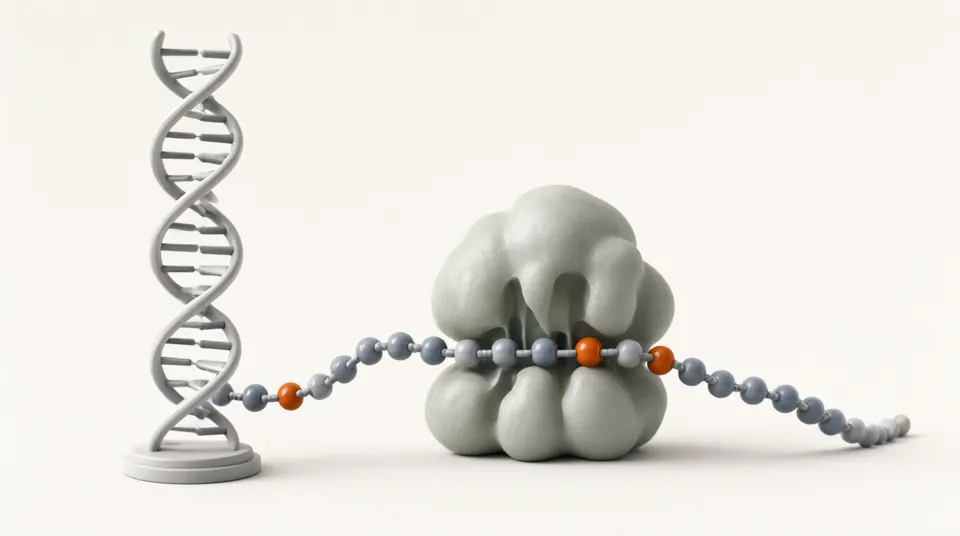
About this experiment
Follow the relationship between coding DNA, its complementary template, an RNA transcript and a polypeptide. Transcribe one base at a time, then let a ribosome window consume complete codons. The chosen frame makes the triplet grouping explicit, and a stop codon ends decoding without adding an amino acid.
Learning goals
- Distinguish coding DNA from the template used for transcription.
- Group a transcript into triplets in a specified reading frame.
- Separate a stop signal from an amino-acid residue.
How to use it
- 1Transcribe a few bases and compare mRNA with coding and template DNA.
- 2Finish the transcript, then decode individual codons while watching the protein grow.
- 3Reach the default stop codon and count amino acids separately from decoded codons.
- 4Change reading frame or apply a different short sequence and compare the lookup products.
The model
Assumptions
- Input is an intron-free coding DNA sequence written 5′ to 3′. Its aligned template is the complement written 3′ to 5′; mRNA matches coding DNA with U replacing T.
- The standard NCBI table 1 genetic code is used. Lookup begins at the selected frame rather than searching for initiation. The first in-frame UAA, UAG or UGA stops decoding.
- Incomplete terminal codons are not translated. RNA processing, initiation machinery, alternative genetic codes, protein folding and expression regulation are excluded. Operation rate is a display control, not a cellular rate prediction.
Try this in class
- Q1Why does the template sequence differ from mRNA while coding DNA nearly matches it?
- Q2Why can shifting the reading frame change every later codon?
Frequently asked questions
Does this predict whether a real cell expresses the entered sequence?
No. It performs transcription correspondence and codon lookup without modeling initiation or regulation.
Why does the stop codon increase the decoded-codon count but not the protein length?
It is a release signal and contributes no amino-acid residue.