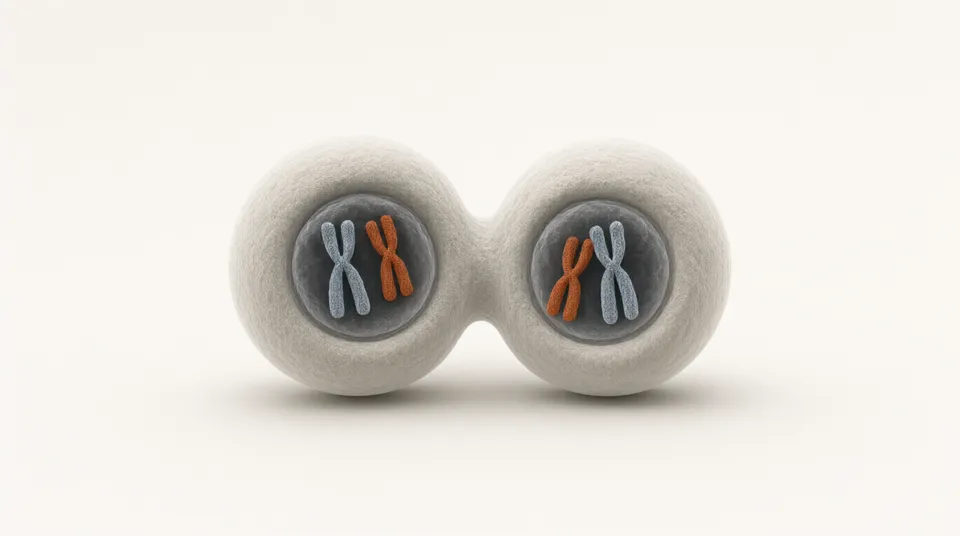
About this experiment
Follow growth, DNA copying and division as separate processes. Scrub through the cycle to compare DNA per cell with total DNA in the tracked system. The chromosome count uses centromeres, making it possible to see why DNA replication and chromosome separation are different events.
Learning goals
- Locate G1, S, G2 and division within a complete cell cycle.
- Distinguish DNA content per cell from total DNA content.
- Track chromosome count without counting replicated sisters as two chromosomes before separation.
How to use it
- 1Record the initial cell count, DNA content and chromosome count.
- 2Move through S phase and compare the changing DNA amount with the unchanged centromere count.
- 3Inspect the late division interval, then complete cytokinesis.
- 4Change chromosome-pair count or cycle duration and repeat the comparisons.
The model
Assumptions
- G1 occupies 35 percent, S 30 percent, G2 20 percent and division 15 percent of the selected cycle. These prescribed fractions are not organism-specific predictions.
- One C is the DNA content of an unreplicated haploid genome. DNA rises from 2C to 4C during S; two daughters each receive 2C. The whole tracked system retains 4C after division.
- The model starts diploid, has no mutation or chromosome loss and does not represent checkpoints or cell death. Total volume grows from one to two initial-cell volumes before splitting; shapes are schematic.
Try this in class
- Q1Why does DNA content double before cell number doubles?
- Q2Why can chromosome count briefly double in one undivided anaphase cell?
Frequently asked questions
Does changing cycle duration change the daughter genome?
No. It rescales the model clock while retaining the same sequence of copying and partitioning.
Why is total DNA not halved after cytokinesis?
The tracked system includes both daughter cells. Only the DNA per cell is halved.