About this experiment
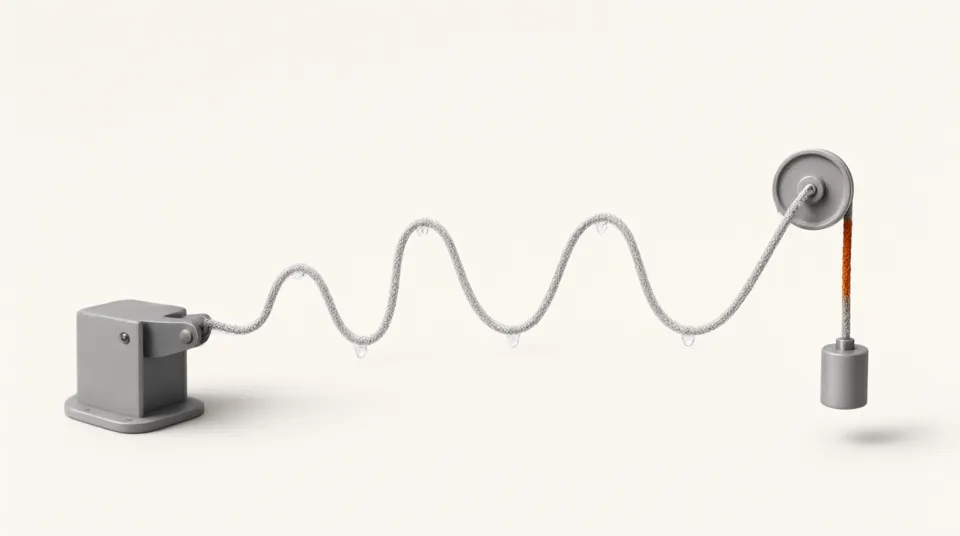
Inspect the natural vibration patterns of a stretched string. Select a harmonic, change the tension, length or mass per unit length, and watch how the physical frequency changes. Orange points mark nodes that remain still; green points mark antinodes with maximum displacement. Playback runs at a fixed slow rate so the shape can be studied even when the real vibration would be too fast to see.
Learning goals
- Identify nodes and antinodes of a fixed-end standing wave
- Relate harmonic number to wavelength and natural frequency
- Predict how tension, length and linear mass density change the frequency
How to use it
- 1Select the first harmonic and use Step to inspect a complete oscillation.
- 2Compare harmonics 1, 2 and 3. Count nodes, including the endpoints.
- 3Keep the harmonic fixed and quadruple the tension. Compare the frequencies.
- 4Double the length, then compare wavelength and frequency with the original values.
The model
Assumptions
- The string is uniform, flexible and under constant tension. Both endpoints are fixed.
- Displacements obey the small-slope linear wave equation. Bending stiffness and damping are ignored.
- Only the selected natural mode is excited. No external driver, resonance bandwidth or mixed harmonics are simulated.
- Display amplitude is enlarged for visibility; playback is fixed at 0.5 cycles per second independently of the physical frequency.
Try this in class
- Q1How many antinodes and nodes does the fourth harmonic have?
- Q2What change in tension doubles the frequency without changing the wavelength?
- Q3Why do the endpoints remain nodes for every harmonic?
Frequently asked questions
Why does increasing tension not make the displayed animation faster?
Playback is deliberately fixed at a slow inspection speed. Tension changes the calculated physical frequency shown in the readout.
Is a standing wave stationary everywhere?
No. Nodes stay at zero displacement, but other points oscillate. The envelope and node positions remain stationary.