About this experiment
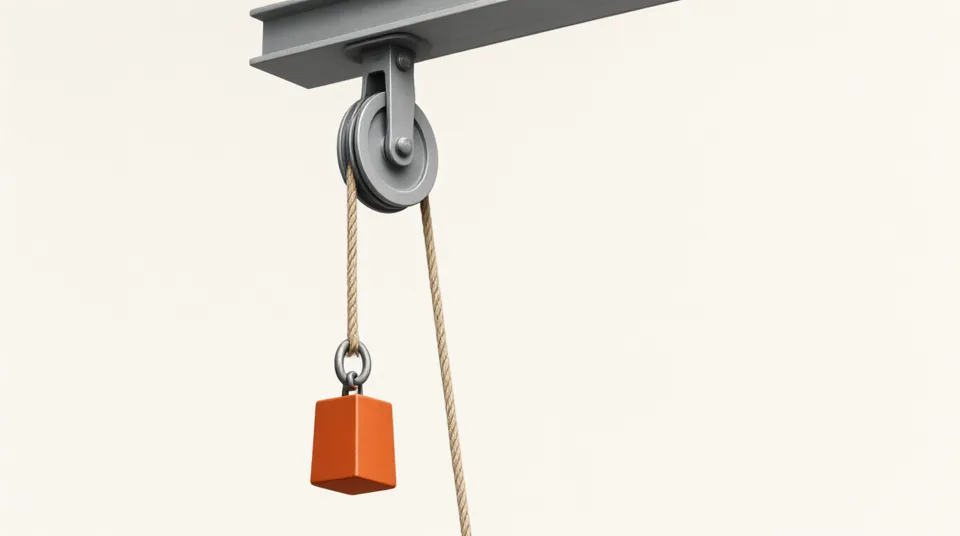
Builders, sailors and crane operators lift heavy loads with pulleys. A single fixed pulley only lets you pull down instead of up, but a block and tackle shares the weight between several ropes, so a person can lift far more than their own weight. Nothing is free though: the rope has to be pulled further. Try six pulley systems, count the supporting ropes, read the effort on a spring balance and check that the work you put in is never less than the work done on the load.
Learning goals
- Describe what fixed and movable pulleys do
- Find the mechanical advantage of a pulley system by counting supporting ropes
- Show that a smaller effort means a longer distance pulled
- Calculate work in, work out and efficiency
- Explain why real pulley systems have an efficiency below 100 %
How to use it
- 1Start with the fixed pulley and a 20 kg load. Compare the effort with the weight. What is the pulley useful for?
- 2Switch to the movable pulley. What is the effort now, and in which direction must you pull?
- 3Try 2, 3, 4 and 5 ropes. Make a table of supporting ropes against effort. What is the rule?
- 4Press Pull the rope and watch the marks on the rope. Which part of the rope moves fastest?
- 5Raise the load by 50 cm in each system and compare the rope pulled with the work in and work out.
- 6Add 2 kg pulleys and 5 % friction. Why does the efficiency fall as you add more pulleys?
The model
Assumptions
- The rope is light and does not stretch, so the tension is the same all along it when there is no friction.
- All supporting rope sections are vertical, and the load is lifted slowly at a steady speed, so there is no acceleration.
- The weight of the movable pulleys is lifted together with the load. Fixed pulleys hang from the ceiling and do not add to the effort.
- Friction is a fixed percentage of the tension lost at each pulley the rope passes over, which is a simple model of real bearings.
- Pulleys are drawn side by side so every rope section can be seen. In a real block and tackle they share one axle.
Try this in class
- Q1A 60 kg load is lifted with 4 supporting ropes. What is the ideal effort? (g = 9.8 N/kg)
- Q2To lift a load 2 m with a 5-rope system, how much rope must be pulled?
- Q3A worker pulls with 150 N to raise a 400 N load with 3 ropes. Find the mechanical advantage and the efficiency.
- Q4Why is a single fixed pulley still useful even though it gives no mechanical advantage?
- Q5Can a pulley system ever reduce the work needed to lift a load? Explain.
Frequently asked questions
Why does the free end not count as a supporting rope when you pull down?
The free end that comes off a fixed pulley pulls on that pulley, which hangs from the ceiling, not on the load. Only rope sections attached to the moving block, or the end you pull upwards on a movable pulley, hold the load up.
Is mechanical advantage the same as velocity ratio?
Only for an ideal system. The velocity ratio comes from the geometry and is always n. The mechanical advantage is measured from the forces and is smaller when there is friction or heavy pulleys.
Where are pulleys used in real life?
Cranes, lifts and elevators, sailing boats, flagpoles, window blinds, gym weight machines and rock climbing rescue systems all use pulleys, often several together.