About this experiment
Build short carbon chains, compare structures with the same molecular formula, and rotate a single bond without changing connectivity. Generated hydrogens make every displayed valence explicit.
Learning goals
- Relate carbon valence to single, double and triple bonds.
- Distinguish structural isomers from conformers.
- Recognise alcohol, ether, alkene, alkyne and aromatic structural motifs.
How to use it
- 1Add carbons to a straight alkane and record its molecular formula.
- 2Compare straight and branched butane; check that both have the same formula.
- 3Compare ethanol with dimethyl ether and inspect the oxygen neighbours.
- 4Return to butane and scan the central dihedral through a full turn while following the illustrative torsion energy.
The model
Assumptions
- Bond lengths and local tetrahedral, trigonal or linear geometries are idealised. Structures are not geometry-optimised quantum calculations.
- Oxygen is shown with an ideal bent local geometry. Hydrogens complete valence; nonbonded steric relaxation is not solved.
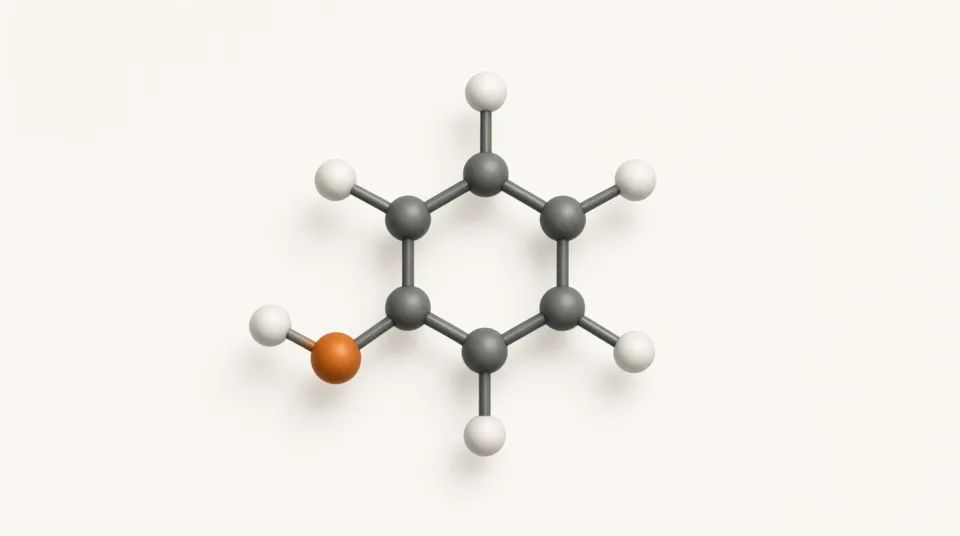
- Benzene uses alternating bond notation for its delocalised aromatic bonding. Space-filling radii are illustrative van der Waals radii.
Try this in class
- Q1Why does rotating butane not create a new connectivity isomer?
- Q2How can identical atom counts give different functional groups?
Frequently asked questions
Can every displayed conformation be a stable minimum?
No. A structure may be imposed at any dihedral angle. Only a simple teaching torsion curve is provided for butane.
Does hiding hydrogens remove them chemically?
No. The molecular formula, mass and valence counts always include all generated hydrogens.