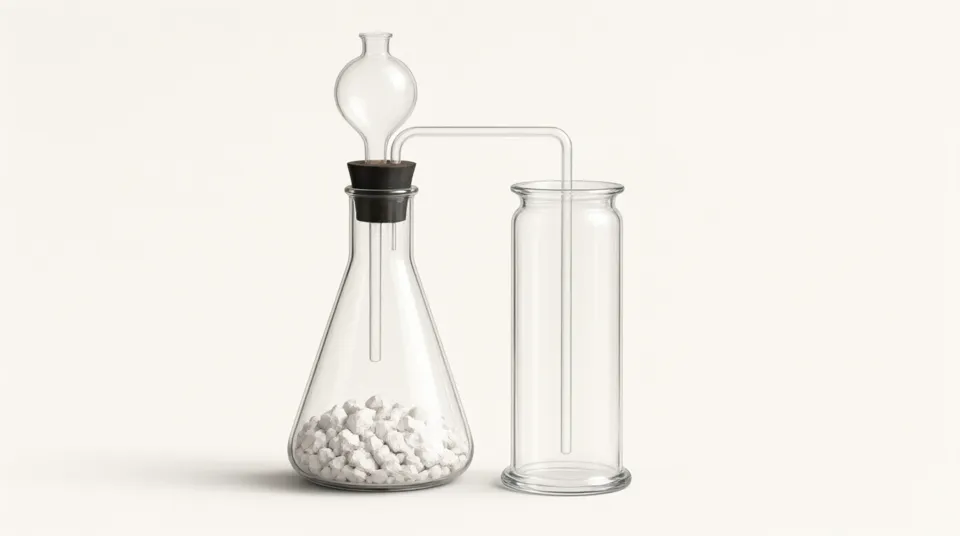
About this experiment
Place limestone in a reaction vessel, attach a gas syringe and add dilute acid. Compare carbonate remaining, acid remaining and collected carbon dioxide as the limiting reactant changes. An open-vessel trial lets the same gas leave the weighing boundary rather than enter the syringe.
Learning goals
- Use the two-to-one acid-to-carbonate reaction ratio.
- Identify the limiting reactant before starting a trial.
- Connect product moles with gas volume and escaped mass.
How to use it
- 1Attach the syringe and run the default limestone and acid trial.
- 2Decrease the acid concentration, repeat and check whether limestone remains.
- 3Increase acid concentration at fixed limestone mass and observe the eventual product ceiling.
- 4Use an open vessel, run again and compare escaped gas mass with the syringe trial.
The model
Assumptions
- The modeled reaction is CaCO₃ + 2HCl → CaCl₂ + CO₂ + H₂O. Limestone is treated as pure calcium carbonate with molar mass 100.0869 g/mol.
- Reaction extent approaches the limiting amount as 1 minus exp(-0.045t), with time in seconds. Particle size, acid activity, passivation and temperature effects on rate are excluded.
- The gas syringe holds dry ideal CO₂ at 298.15 K and the selected pressure, with negligible initial air and no leaks. Dissolution of CO₂ is excluded, so collection over water is not modeled.
Try this in class
- Q1Why can doubling acid volume fail to double the final gas volume?
- Q2What mass leaves the apparatus when the vessel is open?
Frequently asked questions
Why does the syringe not begin with air inside it?
It is an ideal zero-volume gas collector. Dead volume and air dilution are deliberately excluded in this model.
Is remaining limestone evidence that the reaction failed?
Not necessarily. It is the expected outcome when the acid is the limiting reactant.