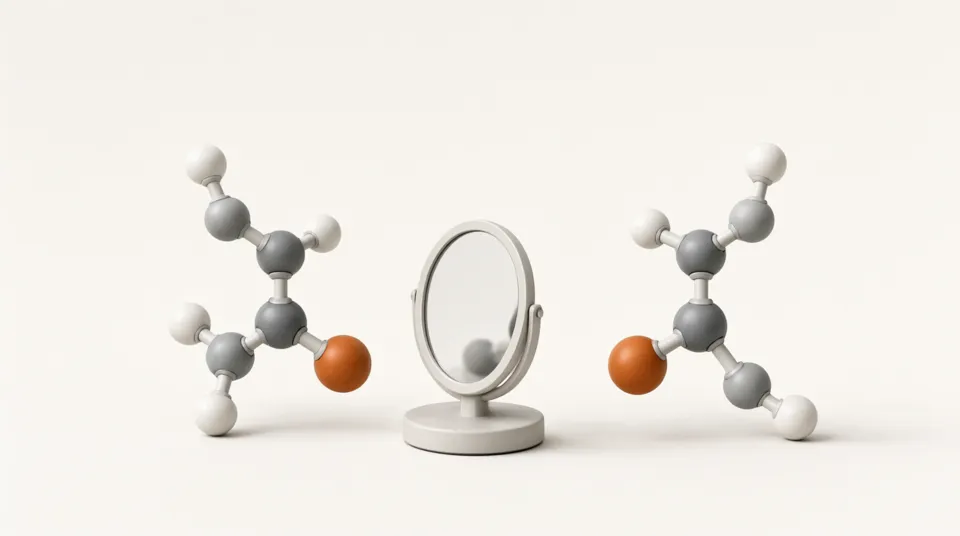
About this experiment
Compare a labelled tetrahedron with its mirror image. Rotate one molecule, superpose their centres and test whether matching atoms can coincide without reflection or a ligand exchange.
Learning goals
- Distinguish a camera rotation from a change of relative molecular orientation.
- Test mirror-image superposability under proper rotations.
- Explain why two identical ligands remove this tetrahedral stereocentre.
How to use it
- 1Superpose the two chiral centres and rotate the right molecule through three axes.
- 2Request the best proper alignment and inspect its nonzero residual.
- 3Exchange two distinct right-hand ligands and repeat the alignment.
- 4Replace Br by a second H, restore the mirror pair and test superposability again.
The model
Assumptions
- The central carbon and four ligand endpoints form an ideal regular tetrahedron. Distances use the centre-to-ligand radius R as a dimensionless length unit.
- The alignment has a closed-form proper rotation for this regular geometry. Duplicate hydrogen labels are matched interchangeably.
- The signed volume depends on ligand ordering and is not a CIP R/S descriptor. Optical rotation, reaction pathways and conformational flexibility are not calculated.
Try this in class
- Q1Why can exchanging two distinct ligands do something a rotation cannot?
- Q2Why must identical hydrogen atoms be allowed to exchange their matching labels?
Frequently asked questions
Does moving the camera change the RMS result?
No. Both molecules are inspected from the same moving camera. The matching calculation uses their relative coordinates.
Does every molecule with a mirror image form an enantiomer pair?
No. A mirror image that can be superposed by proper rotations and matching identical atoms is not a distinct enantiomer in this model.