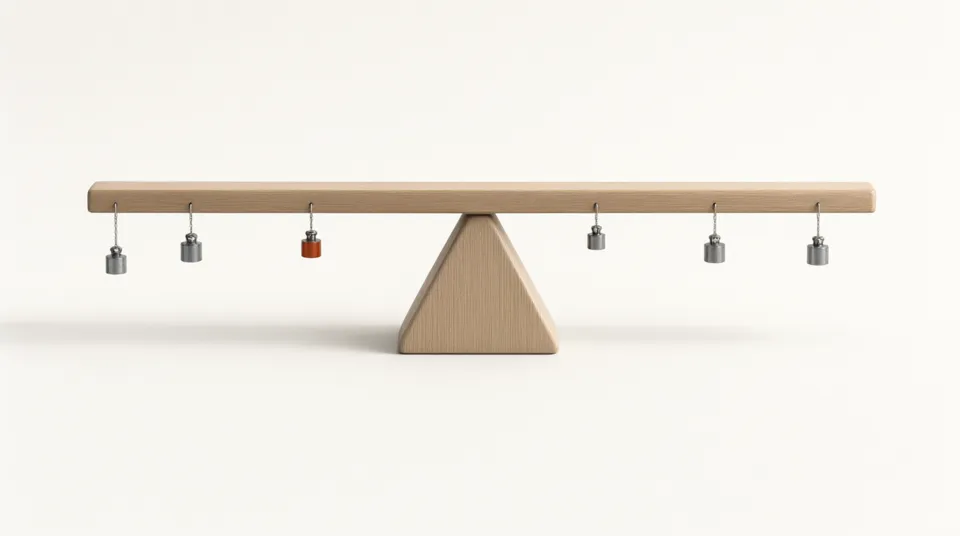
About this experiment
A seesaw balances when the turning effect on one side equals the turning effect on the other. That turning effect, called a moment, depends on both the weight and how far it is from the pivot. Hang weights on this beam, move them along, and move the pivot itself. You will find that a light weight far away can balance a heavy weight close to the pivot, and that a beam with its own weight can balance with nothing on its short side.
Learning goals
- Define the moment of a force as force times perpendicular distance from the pivot
- State the principle of moments: in balance, clockwise moments equal anticlockwise moments
- Use the principle to find an unknown mass or distance
- Explain why the pivot must support the total weight
- Include the weight of the beam, acting at its centre of gravity
How to use it
- 1Start with Equal weights. Move one of the weights one hole closer to the pivot. Which side goes down?
- 2Remove all weights and hang 200 g at 5 holes on the left. Where must you hang 1 kg, 500 g or 200 g on the right to balance it? Look for a rule.
- 3Choose Light far, heavy near. Check that the two moments are equal, even though the weights are not.
- 4Put two different weights on the same side. How do their moments add up?
- 5Remove all weights, switch on Beam has weight and move the pivot away from the centre. Which side goes down, and why?
- 6Choose Heavy beam, pivot off centre. Find a way to balance the beam with one more weight.
The model
Assumptions
- The beam is rigid and the pivot has no friction. The weights hang straight down from the holes, so their distance from the pivot is measured along the beam.
- Holes are 10 cm apart. When the beam is not balanced it tips until it rests on a stop at 12°.
- Unless Beam has weight is switched on, the beam itself is treated as weightless. When it has weight, all 0.5 kg acts at its centre.
Try this in class
- Q1A 30 kg child sits 2 m from the pivot of a seesaw. Where must a 40 kg child sit to balance?
- Q2Why is it easier to open a door by pushing near the handle than near the hinges?
- Q3A spanner with a longer handle makes it easier to undo a tight nut. Use moments to explain why.
- Q4Two weights balance on a beam. What happens if both are moved one hole further from the pivot?
- Q5Why does a crane need a heavy counterweight, and why can the counterweight be moved on some cranes?
Frequently asked questions
Why do the units of a moment look like the units of energy?
Both are newtons times metres, but they are different quantities. In a moment the distance is at right angles to the force and nothing moves; in work the distance is along the force. That is why moments are usually written N·m and energy is written in joules.
Does the beam balance when both sides have the same weight?
Only if the weights are also at the same distance from the pivot. What has to be equal is the moment, weight times distance, not the weight alone.
Why does the pivot force change when weights are added, but not when they are moved?
In balance the pivot must push up as hard as everything pushes down, so the pivot force equals the total weight wherever the weights hang.