About this experiment
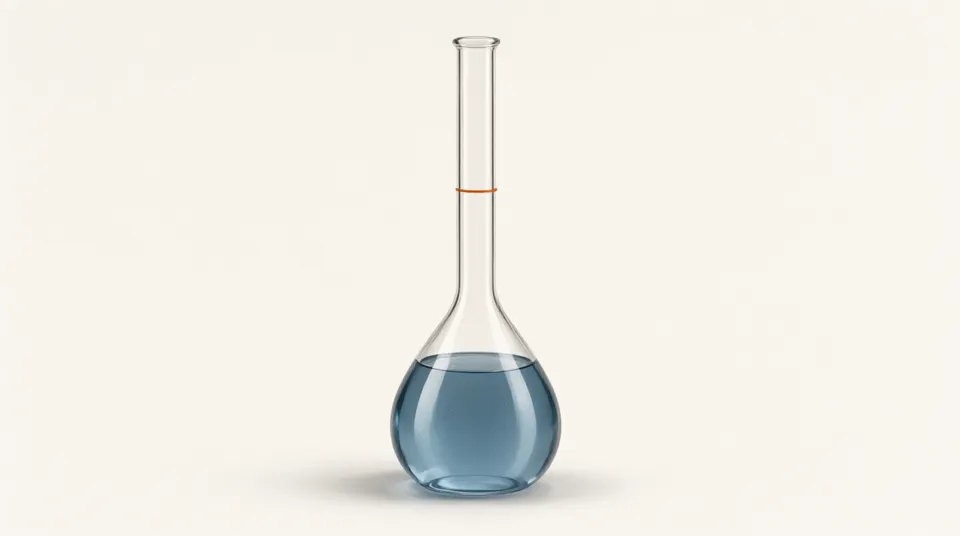
Work through a volumetric preparation at a virtual bench: weigh sodium chloride, dissolve it and fill a stock flask to its mark, pipette an aliquot, then fill a receiving flask to a second mark. Each step updates the apparatus and only prepared quantities appear as active concentration readings.
Learning goals
- Prepare a stock solution, transfer a measured aliquot and dilute it. Check that the solute amount is conserved.
- Use direct apparatus controls, numerical readouts and repeatable trials to test a prediction.
- Explain which physical effects are included and which are deliberately excluded.
How to use it
- 1Choose 5.0 g sodium chloride and a 250 mL stock volume. Weigh, then advance to dissolve and fill to the mark.
- 2Calculate stock concentration using molar mass 58.44 g/mol and compare the prepared reading.
- 3Set the pipette aliquot to 25 mL and transfer it. Record the amount of solute in millimoles.
- 4Fill the receiving flask to 250 mL. Compare the final concentration with C1 times V1 divided by V2.
The model
Assumptions
- Sodium chloride is pure, dissolves completely and has molar mass 58.44 g/mol. Solutions are ideal and at fixed temperature.
- Stock volume and diluted volume are final volumetric readings after filling to the mark, not water volumes added to dry solute.
- Transfers are complete with no losses, evaporation or measurement uncertainty. The sequence illustrates operations without predicting mixing or dissolution kinetics.
Try this in class
- Q1Why must the stock solution be filled to a final mark rather than adding that volume of water to the solid?
- Q2Why does dilution change concentration without changing the transferred solute amount?
Frequently asked questions
Why are concentration readouts zero before the relevant preparation step?
They identify a solution that has not yet been prepared. The final concentration is reported only after the receiving flask has been filled to its mark.
Does the transferred volume always fit in the receiving flask?
Yes. The selected aliquot is at most 50 mL and the receiving final volume is at least 50 mL, so dilution never requires removing solvent.