About this experiment
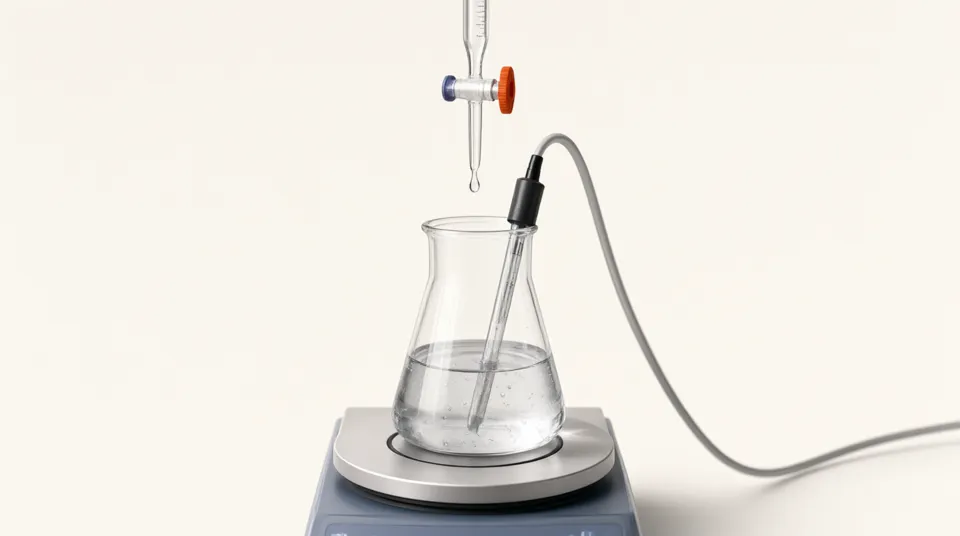
Titrate phosphoric acid with sodium hydroxide in controlled drops. Follow three stoichiometric equivalence volumes while measuring pH and all four phosphate protonation fractions.
Learning goals
- Calculate base equivalents from acid and titrant amounts.
- Relate titration regions to phosphate-species distributions.
- Distinguish an equivalence point from a sharp visible endpoint.
How to use it
- 1Add a 0.05 mL drop and inspect the initial response.
- 2Deliver NaOH toward the first and second equivalence volumes, recording pH and species fractions.
- 3Compare half-equivalence regions with the corresponding pKa values, allowing for overlapping equilibria and water.
- 4Inspect the third equivalence and explain why its aqueous endpoint is poorly resolved.
The model
Assumptions
- pKa values are 2.15, 7.20 and 12.35, with Kw equal to ten to the minus fourteen at 25 °C. Concentrations replace activities.
- All added titrant volume contributes to dilution. The system is closed to carbon dioxide; no phosphate precipitation or other side reaction is included.
- The reservoir is a normalized delivery drawing rather than a calibrated 50 mL burette. The delivery clock controls added volume and is not a neutralization-rate calculation.
- Virtual indicator colour is illustrative; the numerical meter reports pH. The third aqueous equivalence is not assumed to produce a sharp practical endpoint.
Try this in class
- Q1Why does the predominant phosphate species change across successive equivalence regions?
- Q2Why can the third stoichiometric equivalence exist without a clearly resolved indicator endpoint?
Frequently asked questions
Does each equivalent instantly convert every molecule to the next protonation state?
No. Every point is an equilibrium distribution. Even at an equivalence volume, multiple protonation states can coexist.
Are the equivalence volumes fixed when acid or base concentrations change?
No. They scale with the acid amount divided by base concentration. The curve is replotted with the corresponding physical delivery volumes.