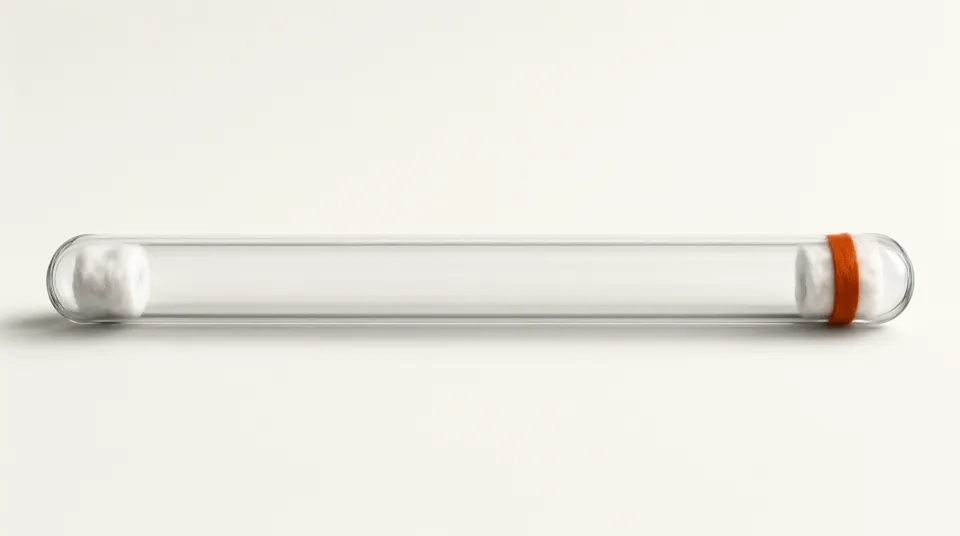
About this experiment
Put a plug of cotton wool soaked in ammonia solution at one end of a long glass tube and one soaked in concentrated hydrochloric acid at the other. Nobody blows the gases along, yet after a few minutes a white ring of ammonium chloride appears inside the tube. The ring is not in the middle: it forms closer to the hydrogen chloride end, because lighter ammonia molecules move faster and diffuse further in the same time. Run the experiment, change the gases and the tube, and compare the ring with the prediction of Graham's law.
Learning goals
- Describe diffusion as the net spreading of particles from high to low concentration
- Explain why the ring forms closer to the hydrogen chloride end
- Relate the speed of gas particles to their molar mass
- Use Graham's law to predict where two gases meet
- Explain why diffusion over long distances is slow even though gas molecules move very fast
How to use it
- 1Start the default experiment. Where does the ring appear? Measure its distance from each end.
- 2Compare the two concentration curves before the ring forms. Which gas has spread further?
- 3Replace HCl with HBr. Does the ring move towards or away from the acid end? Why?
- 4Replace NH₃ with methylamine. How does the position of the ring change?
- 5Halve the tube length. How does the time for the ring to appear change? Is it half as long?
- 6Compare the ring position with the dashed Graham's law prediction.
The model
Assumptions
- Each gas diffuses through still air along the tube. Its diffusion coefficient falls with the square root of its molar mass, starting from 0.23 cm²/s for ammonia.
- The cotton plugs keep the concentration at each end constant. The two gases do not get in each other's way until they react.
- The ring appears where the product of the two concentrations first reaches a fixed threshold. Real rings can shift by a few centimetres because of air currents and how strongly the plugs are soaked.
- The tube is at room temperature. Times are real times; the speed buttons only change how fast the clock runs on screen.
Try this in class
- Q1Gas molecules at room temperature move at hundreds of metres per second. Why does it take minutes for the ring to form?
- Q2Use molar masses to explain why the ring forms closer to the HCl end.
- Q3Predict where the ring would form in a 60 cm tube using NH₃ and HCl.
- Q4How would warming the tube change the time for the ring to form?
- Q5Why must this experiment be done in a fume cupboard?
Frequently asked questions
Why does the simulation not put the ring exactly where Graham predicts?
Graham's law describes gases escaping through a tiny hole. In a tube, molecules diffuse through air and the distance they spread grows with the square root of time. The ring forms where both gases are concentrated enough to react, which comes out close to, but not exactly at, the Graham estimate.
How do I set up the real experiment safely?
Work in a fume cupboard, wear goggles and gloves, and use tweezers to put the soaked cotton wool into each end of a dry glass tube at the same moment. Seal the ends with bungs and keep the tube still and level.
Why does a longer tube take so much longer?
Diffusion distance grows with the square root of time. To reach twice as far, the gases need about four times as long, so doubling the tube length makes the ring take about four times as long to appear.