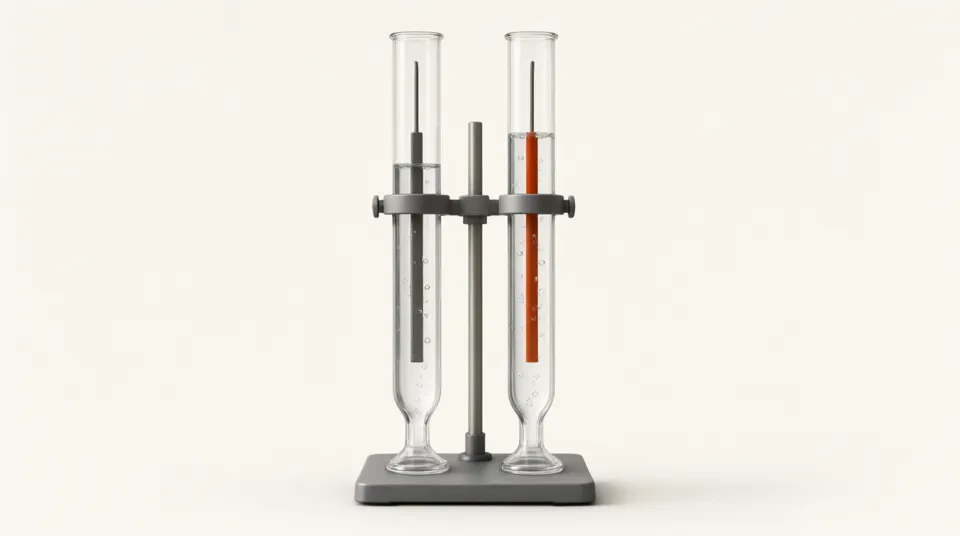
About this experiment
Pass a current through water and it splits into its elements. In a Hofmann voltameter the gases collect in two graduated tubes: hydrogen above the negative electrode, oxygen above the positive one, and always about twice as much hydrogen as oxygen. Turn up the voltage, change the solution, add universal indicator to see acid and alkali form at the electrodes, and test each gas with a splint.
Learning goals
- Identify the products at the cathode and the anode when water is electrolysed
- Explain why the volume of hydrogen is twice the volume of oxygen
- Explain why an electrolyte such as sodium sulfate must be added to pure water
- Write the half equations at each electrode
- Calculate gas volumes from the current and time using Faraday's constant
How to use it
- 1Choose pure water and switch on at 6 V. What do you notice about the current? Then choose sodium sulfate solution.
- 2Collect gas for a few minutes. Read both tubes and compare the volumes.
- 3Test the gas in each tube with a splint. Which gas pops and which relights a glowing splint?
- 4With universal indicator added, describe the colour near each electrode. Which ions are made at each one?
- 5Lower the voltage step by step. Find the voltage below which no gas forms.
- 6Use the charge passed to calculate the moles of electrons, then the volume of hydrogen at 24 L per mole. Check it against the tube.
The model
Assumptions
- Gas forms only above about 1.8 V: 1.23 V is the minimum the reaction needs, and the electrodes need extra (overpotential) to make bubbles.
- Above that, the current is set by the resistance of the solution, which depends on the electrolyte. Pure water has very few ions and barely conducts.
- Every electron makes gas (100 % current efficiency) and no gas dissolves in the water. Volumes are at 20 °C and 101.3 kPa.
- Sodium sulfate, sulfuric acid and sodium hydroxide only carry the current. Their ions are not discharged, so the products are always hydrogen and oxygen.
- Time is speeded up. At 6 V the hydrogen tube fills in about ten real minutes.
Try this in class
- Q1A current of 0.5 A flows for 10 minutes. What volume of hydrogen and of oxygen is collected?
- Q2Why does the indicator turn purple near the cathode and red near the anode?
- Q3In a real voltameter the oxygen volume is often a little less than half the hydrogen volume. Suggest a reason.
- Q4Why would sodium chloride solution be a poor choice of electrolyte for this experiment?
- Q5How long would it take to collect 1 litre of hydrogen with a current of 2 A?
Frequently asked questions
Why add sodium sulfate if it does not react?
Pure water contains only tiny amounts of H⁺ and OH⁻ ions, so it is a very poor conductor. Sodium sulfate adds plenty of ions to carry the current through the solution, while water itself is still what is oxidised and reduced at the electrodes.
Why is the volume ratio 2 : 1?
Each hydrogen molecule needs 2 electrons and each oxygen molecule releases 4. The same number of electrons flows through both electrodes, so twice as many hydrogen molecules form. Equal numbers of gas molecules take up equal volumes (Avogadro), giving twice the volume.
What happens with sodium chloride solution?
Chloride ions are oxidised at the anode instead of water, especially in concentrated solution, giving toxic chlorine gas. The cathode still gives hydrogen. This is the chlor-alkali process used in industry, not a safe classroom demonstration.