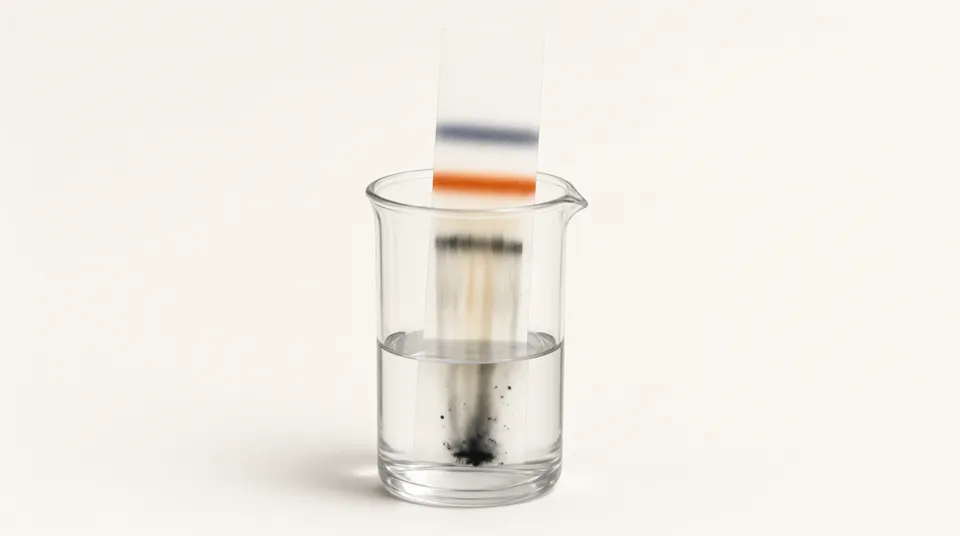
About this experiment
A ransom note was written in black ink, and four suspects each own a different black pen. Most inks are mixtures of several dyes, and paper chromatography can pull them apart. A solvent soaks up the paper and carries each dye along with it; dyes that stick less to the paper and dissolve better travel further. Spot the note and the four pens on a pencil baseline, run the paper in water or ethanol, measure Rf values and find the pen that wrote the note.
Learning goals
- Describe how to set up paper chromatography and explain each precaution
- Explain separation in terms of solubility in the solvent and attraction to the paper
- Calculate Rf values from measured distances
- Use a chromatogram to identify the components of a mixture and match unknown samples
- Explain why the solvent affects the result
How to use it
- 1Before running, predict: will each black ink stay as one spot or split up?
- 2Press Run with water as the solvent. Watch the solvent front. Does it rise at a steady speed?
- 3When the run finishes, count the spots in each lane. Which inks are mixtures?
- 4Tap spots to measure them. Record the distance moved by each spot and by the solvent front, and calculate Rf.
- 5Decide which pen wrote note X and choose it. Explain your evidence using Rf values, not only colours.
- 6Repeat the run with ethanol. Which dye moves the furthest now? Why does the order change?
- 7Turn on the mistake: solvent above the baseline. What happens to the spots?
The model
Assumptions
- The Rf values are illustrative and chosen to separate well. Real values depend on the paper, the temperature and the exact solvent.
- Each dye keeps the same Rf all the way up the paper. Spots spread as they travel, as they do on real paper.
- The baseline is drawn in pencil, which does not dissolve. The run stops when the front is 1 cm from the top.
- If the solvent covers the baseline the dyes dissolve into the solvent in the jar instead of rising.
Try this in class
- Q1A spot moves 4.2 cm while the solvent front moves 10.5 cm. What is its Rf value?
- Q2Why is the baseline drawn in pencil and not in ink?
- Q3Why must the solvent level be below the baseline?
- Q4A substance stays on the baseline in water. Suggest why, and what you could change to make it move.
- Q5Why is a lid often placed on the jar during the run?
Frequently asked questions
Why compare Rf values instead of just colours?
Different dyes can have very similar colours. Two dyes are only likely to be the same substance if they have the same Rf in the same solvent, ideally in more than one solvent.
What is the stationary phase and the mobile phase?
The stationary phase is the paper (more exactly, water held in the cellulose fibres). The mobile phase is the solvent that moves up through it. Each substance shares itself between the two phases, and that balance sets its Rf.
Can a pure substance give more than one spot?
No. A pure substance gives a single spot in every solvent. More than one spot means a mixture, although two substances can share a spot by chance, so a single spot does not prove purity.