About this experiment
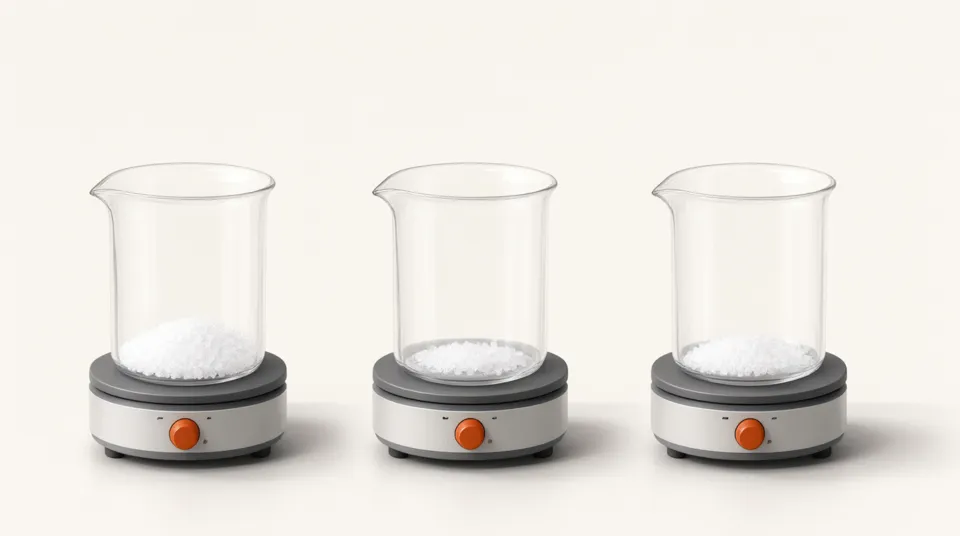
Stir sugar into tea and it disappears, but keep adding more and eventually some stays at the bottom: the solution is saturated. How much a substance can dissolve depends on the temperature, and a solubility curve shows exactly how. Add salt to water in a beaker, heat and cool it, and follow the mixture as a point on the graph. When the point is above the curve, crystals are left over; cooling a hot saturated solution makes crystals appear.
Learning goals
- Define solubility and saturated solution
- Read solubility values from a solubility curve
- Use a solubility curve to decide whether a mixture is saturated or unsaturated
- Calculate the mass of crystals formed when a saturated solution is cooled
- Explain how crystallisation by cooling separates substances with different solubility curves
How to use it
- 1With potassium nitrate at 20 °C, add salt slowly until crystals stay at the bottom. Compare the mass with the solubility readout.
- 2Add 100 g of potassium nitrate to 100 g of water at 20 °C. Heat to 80 °C. What happens to the crystals?
- 3Now cool the solution to 10 °C. At what temperature do crystals start to appear? How many grams form?
- 4Repeat with sodium chloride. Why is cooling a poor way to get salt crystals from sea water?
- 5Double the water to 200 g. How does the mass that can dissolve change? Does the solubility change?
- 6Choose lithium sulfate and heat a saturated solution. What is unusual about its curve?
The model
Assumptions
- Values come from standard data tables at 10 °C steps and are joined by a smooth curve that never overshoots the table.
- The solution always reaches equilibrium straight away. Real solutions can stay supersaturated for a while before crystals appear.
- No water evaporates when the solution is heated. Copper sulfate is counted as anhydrous CuSO₄, although it crystallises as the blue hydrate.
Try this in class
- Q1What is the solubility of potassium nitrate at 50 °C?
- Q2At 40 °C, 50 g of potassium chloride is stirred into 100 g of water. Is the solution saturated? How much does not dissolve?
- Q3A saturated solution of potassium nitrate in 100 g of water is cooled from 60 °C to 20 °C. What mass of crystals forms?
- Q4A mixture of potassium nitrate with a little sodium chloride is dissolved in hot water and cooled. Which substance crystallises out first? Why?
- Q5Gases become less soluble in water as it gets warmer. Why can this harm fish in rivers next to power stations?
Frequently asked questions
Why do most solids dissolve better in hot water?
For most salts, dissolving takes in energy from the surroundings. Raising the temperature supplies that energy, so more of the solid can dissolve before the solution is saturated.
What does a point below the curve mean?
The solution is unsaturated: it holds less solute than it could at that temperature, so more could still dissolve. A point above the curve means some solid stays undissolved.
Why is the sodium chloride curve so flat?
Its solubility hardly changes with temperature: about 36 g at 20 °C and 40 g at 100 °C. To get salt from sea water you must evaporate the water rather than cool it.