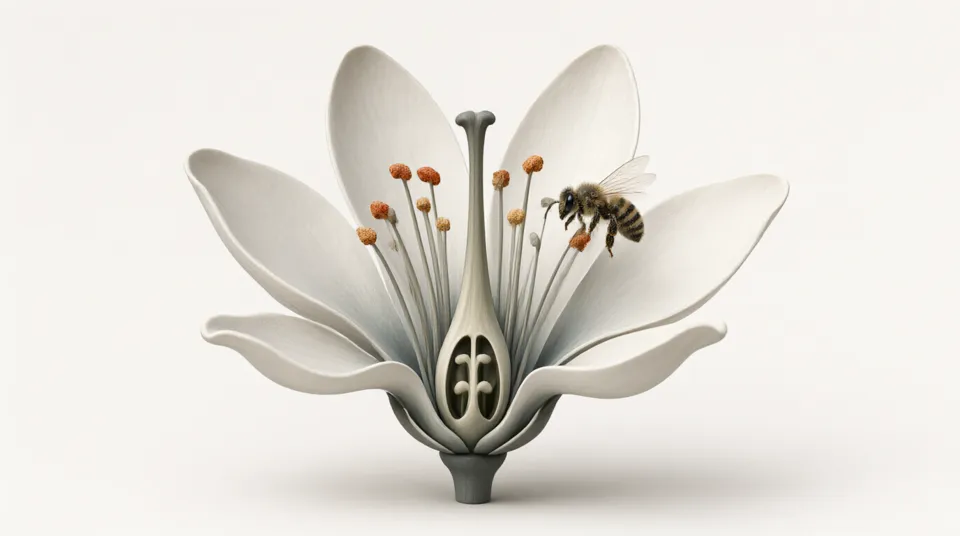
About this experiment
Collect pollen from an anther and place it on a stigma, then follow the delay before a compatible pollen tube reaches an ovule. Compare self-pollination, cross-pollination and incompatible transfers.
Learning goals
- Distinguish pollen deposition from fertilization.
- Explain how viability and compatibility limit successful pollen tubes.
- Relate style length and tube growth to the time of arrival.
How to use it
- 1Collect donor pollen and deposit it on the other flower.
- 2Advance time and inspect growing tubes before any ovule is fertilized.
- 3Repeat a self transfer with self compatibility disabled.
- 4Change the species setting or pollen viability and compare deposited grains with successful ovules.
The model
Assumptions
- Each pickup carries five grains. Viability is a saved seeded draw, and compatibility is determined when the grain is deposited.
- The simplified compatibility rule rejects same-flower pollen when self compatibility is disabled and cross transfers when the two flowers are set to different species.
- Accepted grains wait one hour, then grow at a common illustrative temperature-dependent speed through the selected style length.
- Each flower contains eight ovules. Accepted tubes are assigned in arrival order, with at most one fertilization per ovule.
- The apparatus displays up to 40 pollen symbols per flower and allows 80 deposited grains per trial. Readouts retain the actual number. It stops at fertilization and does not resolve the two cellular fusion events of angiosperm double fertilization.
Try this in class
- Q1Why does deposited pollen not imply an immediate seed?
- Q2Why can additional pollen fail to increase fertilized ovules once all eight are occupied?
Frequently asked questions
Are pollination and fertilization the same step?
No. Pollination places pollen on the stigma. Fertilization requires later successful growth and arrival at an ovule.
Does the model simulate fruit growth?
No. Fertilized ovules are counted, while fruit development and later seed maturation are outside its scope.