About this experiment
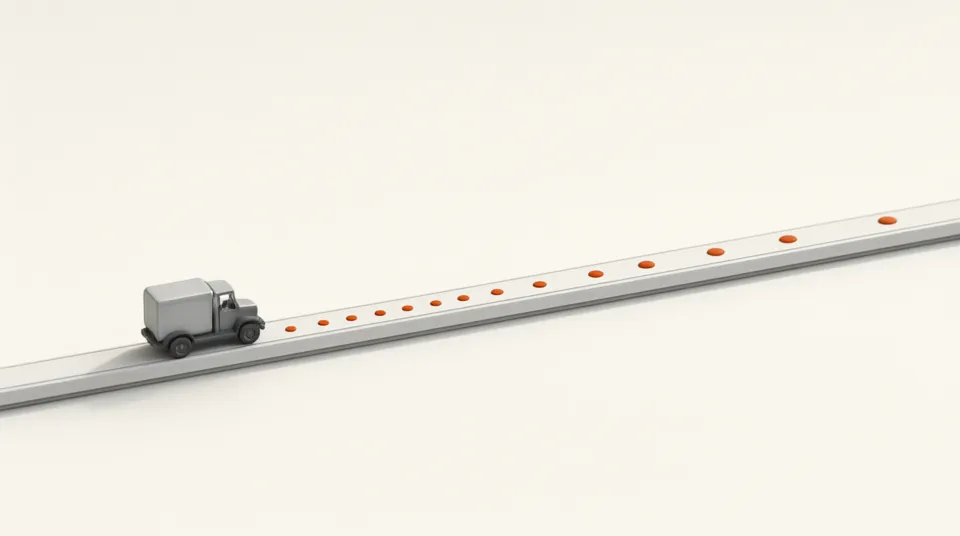
Acceleration changes velocity, but a positive acceleration does not always mean an object is speeding up. Start a cart with negative velocity and positive acceleration to watch it slow, stop and reverse. The velocity-time graph crosses zero at the turning point; its signed area gives displacement.
Learning goals
- Investigate how time affects velocity while controlling the other variables.
- Use the graph and numerical readings to test a prediction.
- Explain the physical assumptions and where this model stops applying.
How to use it
- 1Use the defaults. Predict the time at which the cart reverses, then scrub through 2 s.
- 2Save the curve and change acceleration to -2 m/s². Compare the slopes.
- 3Set acceleration to zero. What determines the horizontal line?
- 4Set initial velocity to zero and double time. Compare velocity and displacement.
The model
Assumptions
- Acceleration is constant and motion starts at the coordinate origin.
- No collision or track boundary is modelled. The fixed ruler spans -400 m to 400 m.
Try this in class
- Q1Why can acceleration be positive while speed decreases?
- Q2What is the displacement at 4 s with initial velocity -4 m/s and acceleration 2 m/s²?
Frequently asked questions
Why does the cart return to the origin?
With these defaults, the negative displacement before 2 s cancels the positive displacement from 2 s to 4 s.
Does the graph show speed?
It shows signed velocity. Speed is the absolute value of velocity, so it cannot be negative.