About this experiment
Dilute a weak electrolyte, add a common ion and compare pH, ionized fraction and estimated conductivity. The ionization equilibrium is solved from mass and charge balance rather than a square-root shortcut.
Learning goals
- Distinguish concentration from degree of ionization.
- Predict dilution and common-ion effects for acids and bases.
- Relate ionic populations to an illustrative conductivity estimate.
How to use it
- 1Record the initial weak acid pH and ionized fraction.
- 2Add water and compare the fraction ionized with the falling analytical concentration.
- 3Reset and add HCl; observe how a common hydrogen ion suppresses acid ionization.
- 4Switch to a weak base and repeat using NaOH as the common-ion reagent.
The model
Assumptions
- Water autoionization is fixed at Kw = 10 to the minus fourteen at 25 °C. Activities and ionic-strength effects are omitted.
- The sample starts at 100 mL. Diluent and 0.1 M strong-reagent volumes contribute to the total volume; common ions are added as HCl or NaOH, not as a conjugate salt.
- The conductivity coefficients approximate acetate, ammonium and common spectator ions. Changing pK creates an illustrative analogue rather than a new measured substance.
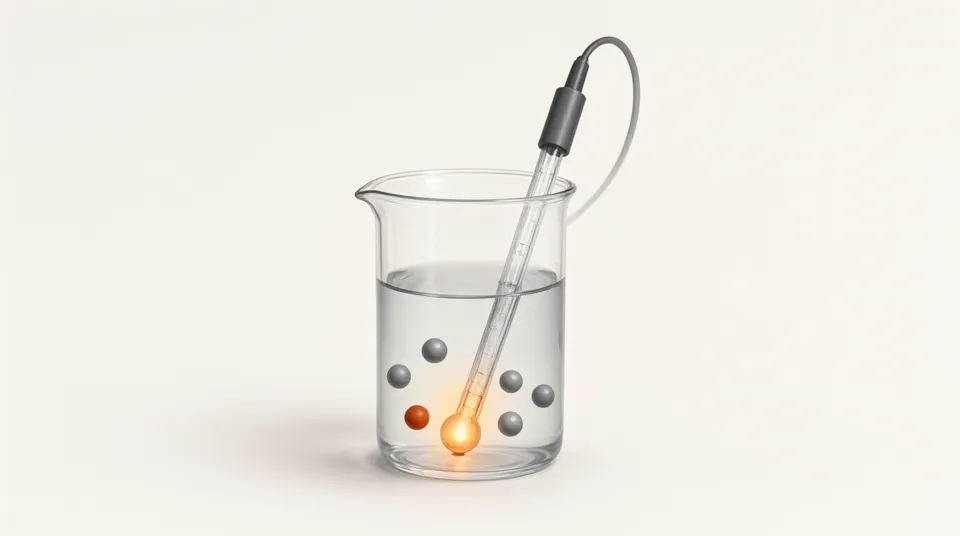
- Meter colour is a virtual indicator overlay. Particle colours are representative fractions, not individual electron or molecular trajectories.
Try this in class
- Q1Why can ionized fraction increase while the concentration of ions decreases on dilution?
- Q2Why does a common strong acid reduce the weak-acid anion fraction even while total conductivity rises?
Frequently asked questions
Does this always use the square-root ionization formula?
No. The full electroneutrality equation includes water and strong electrolyte, so it remains usable when the usual small-ionization approximation fails.
Does added water change the number of weak-electrolyte formula units?
No. It changes the total volume and equilibrium distribution, while the analytical amount of weak electrolyte remains fixed.