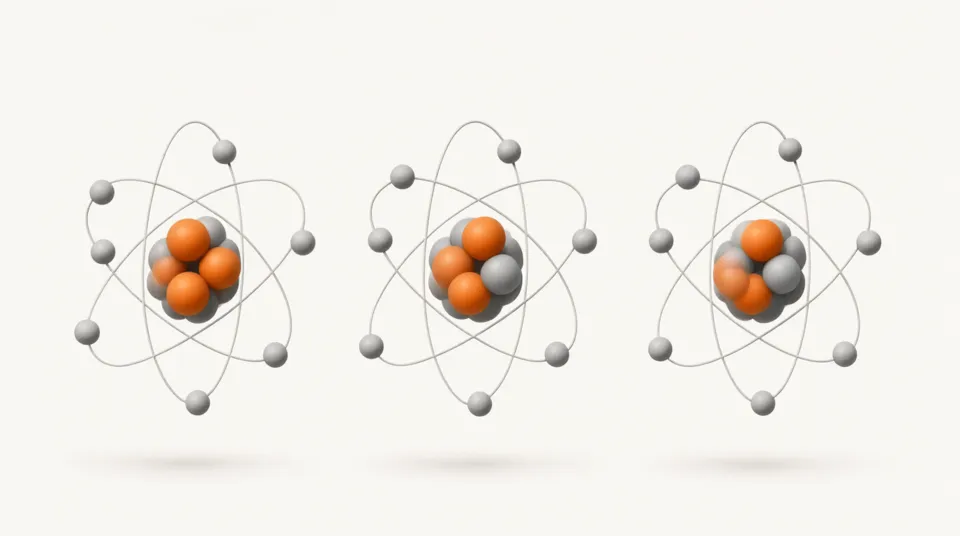
About this experiment
Mix isotopes of one element, calculate the average atomic mass and launch ions through a magnetic sector. Separate changes in abundance from changes in mass, ion charge and instrument geometry.
Learning goals
- Calculate an abundance-weighted mean mass.
- Relate mass-to-charge ratio to a mass spectrum.
- Test how accelerating voltage and magnetic field affect an ion path.
How to use it
- 1Record the representative chlorine mixture and compare its mean mass with 35 and 37.
- 2Increase the lighter fraction to one and predict the remaining spectrum peak.
- 3Launch the ions and compare their radii and arrival times.
- 4Double the magnetic field and test whether both radii halve while the mean atomic mass stays fixed.
The model
Assumptions
- Masses and representative abundance values are from NIST. Natural isotopic abundances can vary between samples.
- Ions have the same selected positive integer charge. Electron rest masses are subtracted; ionisation binding-energy mass corrections are neglected.
- Acceleration is instantaneous at injection; the magnetic field is uniform. Collisions, beam width and detector response are omitted. The fitted drawing scale does not change the millimetre readouts.
Try this in class
- Q1Why does changing abundance alter peak height but not peak position?
- Q2Why is an isotope mass different from its integer mass number?
Frequently asked questions
Is the weighted average the mass of one atom?
Usually no. It is the number-weighted average for a population of isotopes; an individual atom has one isotopic mass.
Does a higher charge bend the beam more strongly?
At fixed voltage and mass, radius is inversely proportional to the square root of charge. The ion also leaves the accelerator faster.