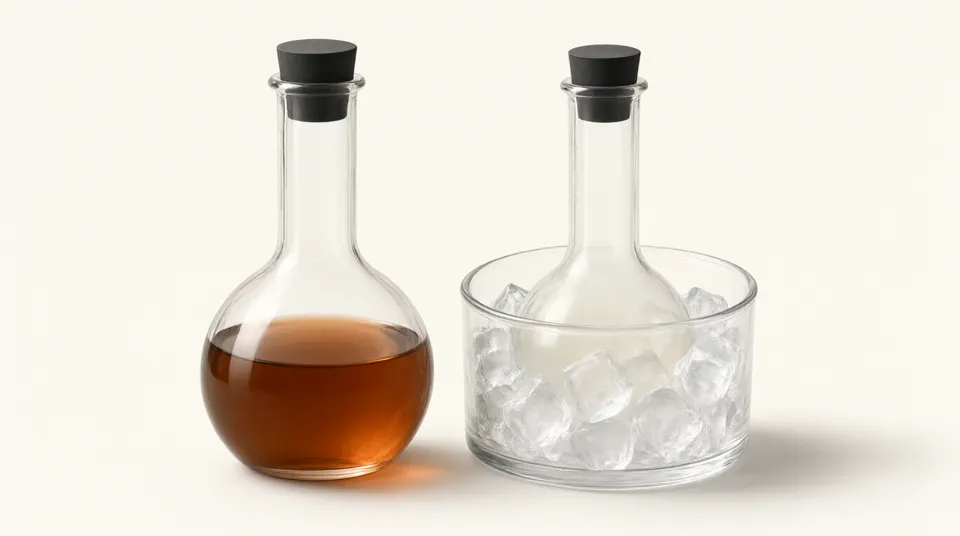
About this experiment
Explore a reversible gas reaction between pale N₂O₄ and brown NO₂. Heating favors dissociation in this endothermic model, while compression favors the side with fewer gas molecules. Compare the two reaction rates: at dynamic equilibrium they become equal even though both reactions continue. Every parameter change begins a fresh run from the selected initial amounts.
Learning goals
- Distinguish dynamic equilibrium from a reaction that has stopped
- Predict the effects of temperature, volume and initial concentration on equilibrium composition
- Connect equal forward and reverse rates with the equilibrium concentration quotient
- Apply Le Chatelier's principle to changes in temperature and volume
- Explain why changing the volume does not change Kc but does change the equilibrium amounts
How to use it
- 1Play at 298 K and 1 L until the two rate readouts approach equality. Compare the two concentrations.
- 2Raise temperature to 350 K, start the new run and compare the final brown NO₂ concentration and Kc.
- 3At a fixed temperature, reduce volume and compare the final amounts, concentrations and pressure.
- 4Add some initial NO₂ with the Initial NO₂ amount slider and inspect the initial reverse rate and the approach to equilibrium.
- 5Set the volume to 5 L and compare how long it takes to reach equilibrium with the 1 L case.
The model
Assumptions
- The gas is ideal, well mixed and held at a uniform fixed temperature and volume during each run.
- Chosen teaching parameters are Kc = 0.006 mol/L at 298 K, reaction enthalpy 57 kJ/mol, and reverse rate constant 5 L/(mol s). They are illustrative, not a fitted experimental dataset.
- The reverse rate constant is held fixed and the forward constant is kr times Kc. The analytic solution conserves NO₂ equivalents exactly.
- Every run starts with 0.10 mol N₂O₄ and the selected NO₂ amount. Particle icons identify species and do not represent accurate atomic structures.
Try this in class
- Q1Why does the brown gas become more abundant when temperature rises in this model?
- Q2Does compression necessarily reduce the final NO₂ concentration, or can amount and concentration change differently?
- Q3At equilibrium, why can both reaction rates be positive while net concentration change is zero?
- Q4A sealed flask of brown gas is put in ice water. What happens to the colour, and why?
- Q5A catalyst would speed up both reactions equally. Would it change the final concentrations?
Frequently asked questions
Does changing volume change Kc?
At fixed temperature, no. Volume changes concentrations and therefore shifts the equilibrium amounts. Kc changes with temperature in the selected thermodynamic model.
Why does heating create a new curve from time zero?
The controls compare separate closed-system runs from the selected initial amounts. They do not simulate a temperature ramp or a piston compression during one continuous run.
Why use N₂O₄ and NO₂ as the example?
It is a classic classroom demonstration because NO₂ is brown and N₂O₄ is almost colourless. Sealed tubes of the gas mixture visibly darken in hot water and fade in ice water, which makes equilibrium shifts easy to see.