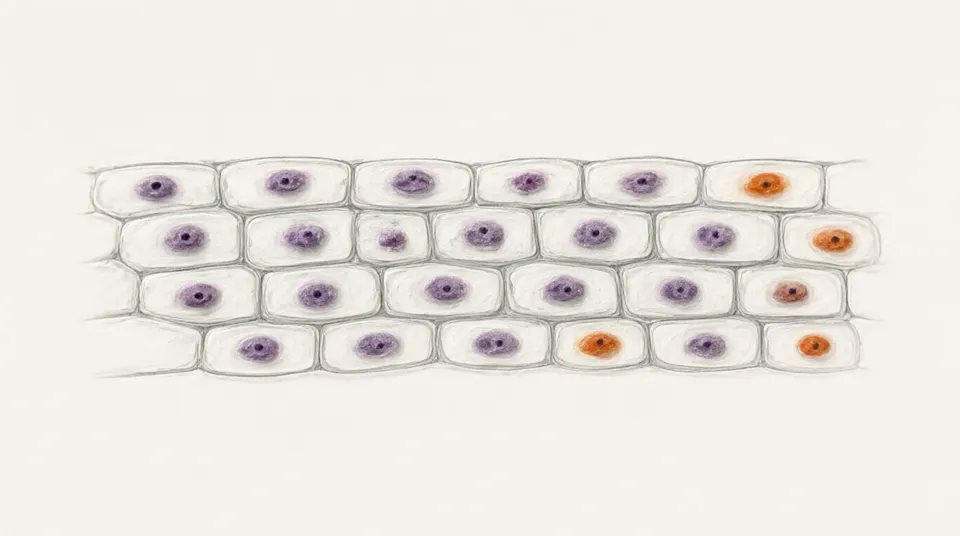
About this experiment
Exchange the solution around a virtual onion-cell section and observe the protoplast withdraw from the wall or recover. Compare water potentials and distinguish the fixed wall from the changing cell contents.
Learning goals
- Use solute concentration and pressure to compare water potentials.
- Identify plasmolysis as loss of membrane contact and turgor.
- Explain why rinsing must preserve the starting volume of a shrunken cell.
How to use it
- 1Run the starting concentrated-bath trial for ten minutes.
- 2Record protoplast volume, turgor and membrane contact.
- 3Rinse with water and verify that volume is continuous at the instant of exchange.
- 4Continue recovery and compare the cell and bath water potentials near equilibrium.
The model
Assumptions
- The wall volume is fixed. Model solute remains inside the membrane while water can move. Controls use total osmolarity, not salt formula-unit molarity.
- Solute potential follows the ideal van't Hoff relation. Wall stress is zero below volume 0.7 and increases as k(V-0.7)/(1-V) above that threshold.
- Equilibrium is found by balancing osmotic and wall pressures. Transient volume relaxes exponentially toward that equilibrium; this is a phenomenological approximation, not a resolved membrane-flow law.
- Below 0.7 reference volume the membrane withdraws. Above it the membrane remains against the wall while internal volume and turgor change.
- Changing the bath preserves current volume and restarts elapsed exchange time. Changing cell parameters begins a fresh water-equilibrated cell trial.
Try this in class
- Q1Why does turgor become zero before the fixed wall disappears?
- Q2Why can water enter a cell whose solute concentration is already lower than before rinsing?
Frequently asked questions
Is the osmolarity control identical to NaCl molarity?
No. Osmolarity counts dissolved particles. Salt dissociation makes a formula-unit molarity a different quantity.
Why does the membrane not shrink away while turgor is positive?
The geometry keeps the membrane in wall contact until the specified relaxed-volume threshold is crossed.