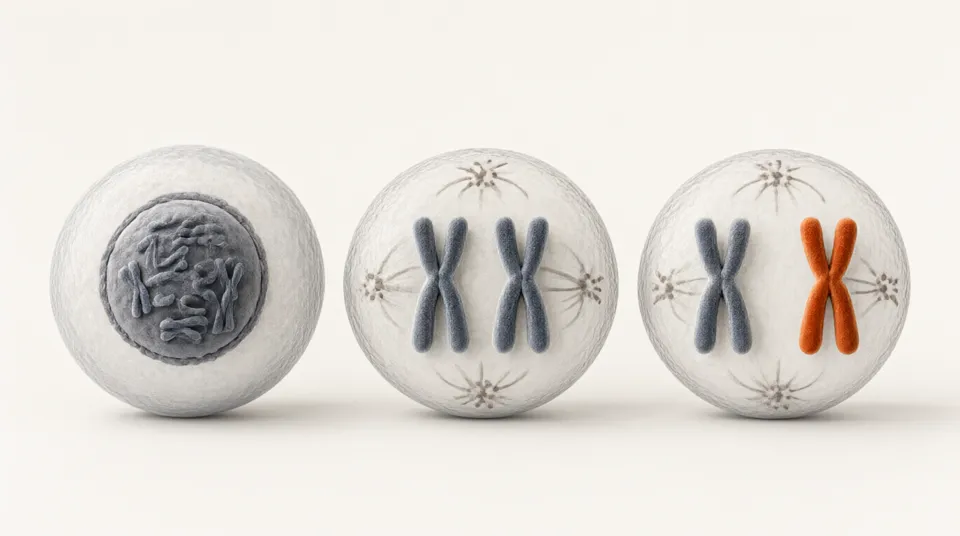
About this experiment
Inspect a cell before replication, then follow replicated chromosomes through mitosis. At metaphase, align the centromeres yourself before permitting anaphase. Comparing DNA with centromere count exposes the distinction between a replicated chromosome and its two separated daughter chromosomes.
Learning goals
- Identify the major mitotic events in a reproducible sequence.
- Explain why sister separation changes chromosome count without creating DNA.
- Connect correct metaphase alignment with equal chromosome distribution.
How to use it
- 1Compare G1 with prophase after DNA replication. Record total DNA and chromosome count.
- 2Advance to metaphase and drag chromosome centromeres toward the central plane.
- 3Pass the alignment checkpoint and observe sister chromatids separate.
- 4Complete cytokinesis and compare the two diploid daughters with the initial genome.
The model
Assumptions
- The starting cell is diploid with one to three homologous pairs. S phase is completed between the first two snapshots.
- The checkpoint requires every modeled centromere to be within 0.15 drawing units of the plane. This is an interaction rule, not a biochemical checkpoint model.
- No crossing over, nondisjunction or mutation occurs. DNA remains 4C across mitosis and is shared as 2C per final daughter. Separate sisters are counted as chromosomes after centromeres split.
Try this in class
- Q1Why are there twice as many chromosomes after anaphase but no extra DNA synthesis?
- Q2Why is chromosome replication insufficient by itself to produce two complete cells?
Frequently asked questions
Why can the next phase be disabled at metaphase?
The interactive checkpoint requires centromere alignment. Drag them into place or use the explicit alignment control.
Are sister chromatids and homologous chromosomes interchangeable terms?
No. Sisters arise by replication of one chromosome, while homologs are the corresponding chromosomes in the two inherited sets.