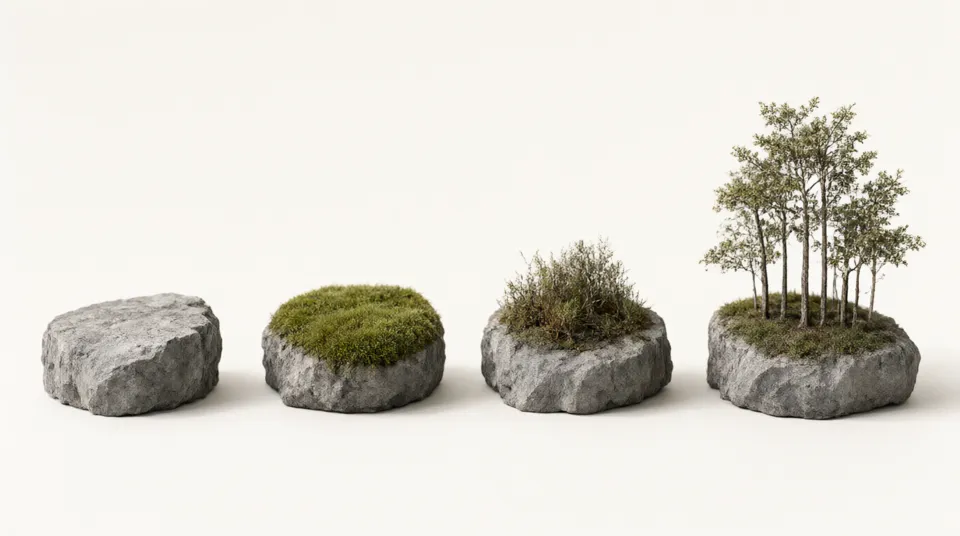
About this experiment
Watch a landscape change from bare ground through pioneer and shrub cover to forest. Apply a disturbance to the current landscape, compare recovery and verify that land area remains fully accounted for.
Learning goals
- Describe a possible sequence of changing land-cover proportions.
- Separate recovery dynamics from an instantaneous disturbance.
- Verify total land area before and after a disturbance.
How to use it
- 1Run the default landscape and inspect several land-cover stages.
- 2Inspect year 80, then disturb the current landscape.
- 3Continue the run and compare pioneer recovery with forest recovery.
- 4Vary disturbance severity and transition rates while checking total cover.
The model
Assumptions
- The four cover fractions start at entirely bare ground and transfer sequentially through first-order transitions. All rates are illustrative per-year coefficients.
- One instantaneous disturbance returns the chosen fraction of all vegetated cover to bare ground. It preserves the sum of cover fractions.
- There are no seed dispersal limits, species interactions, soil feedbacks or repeated disturbances. Forest is an absorbing state in this chosen model.
- This is one schematic pathway, not a claim that every ecosystem reaches forest or follows a universal climax sequence.
- The 64 displayed patches approximate continuous cover proportions. Editing a planned disturbance changes the compared history; Disturb now applies it at the current model time.
Try this in class
- Q1Why can pioneer cover rise after a late disturbance?
- Q2Which model changes would be needed for a grassland that does not become forest?
Frequently asked questions
Does this predict how long a real forest takes to develop?
No. The timescale is illustrative, and real succession depends on environment, dispersal and many omitted interactions.
Why is there only one disturbance?
The model isolates one pulse so its immediate area transfer and later recovery can be examined clearly.