About this experiment
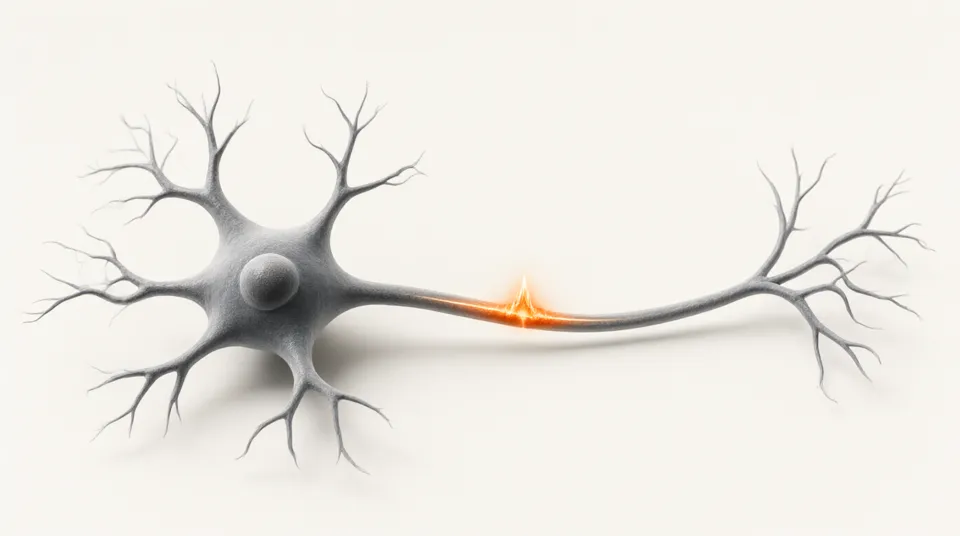
Every thought and every heartbeat relies on action potentials: brief spikes of voltage that race along nerve and muscle cells. At rest the inside of a neuron is about 65 mV negative. A small push does almost nothing, but once the voltage passes a threshold, sodium channels fly open, sodium rushes in and the inside swings positive for a millisecond before potassium channels restore it. Stimulate the squid giant axon studied by Hodgkin and Huxley, find the threshold, test the refractory period and block the channels with toxins.
Learning goals
- Describe the resting potential and the changes in voltage during an action potential
- Explain depolarisation and repolarisation in terms of sodium and potassium channels
- Explain the all-or-nothing nature of the action potential and the idea of a threshold
- Explain the refractory period and why it makes impulses travel one way
- Predict the effect of drugs and toxins that block ion channels
How to use it
- 1Press Below threshold, then Just above threshold. Compare the two traces. Is there a half-sized action potential?
- 2Increase the stimulus current from 8 to 30 µA/cm². Does the action potential get bigger?
- 3Switch the lower graph to Conductances. Which channels open first, sodium or potassium? Which close first?
- 4Press Two quick pulses. Why does the second pulse not cause an action potential? Increase the time between pulses until it does.
- 5Block the sodium channels step by step. At what point do action potentials stop?
- 6Block the potassium channels instead. How does the shape of the action potential change?
The model
Assumptions
- A small patch of squid giant axon membrane at 6.3 °C, with the original 1952 rate equations shifted so the resting potential is -65 mV.
- E_Na = +50 mV and E_K = -77 mV. The ion concentrations do not change during a few action potentials.
- The equations are solved with a fourth-order Runge-Kutta method in steps of 0.01 ms. The patch is uniform, so the impulse does not travel along an axon here.
- Blocking a share of channels lowers the maximum conductance by the same share, as TTX and TEA do.
Try this in class
- Q1Explain why the inside of the membrane becomes positive at the peak of the action potential.
- Q2Why can the peak never go above E_Na?
- Q3Why does a stronger stimulus not give a bigger action potential? How does the nervous system code a stronger stimulus instead?
- Q4During the absolute refractory period no stimulus can trigger a new action potential. Which gate is responsible?
- Q5Pufferfish contain tetrodotoxin (TTX). Explain why eating badly prepared pufferfish can stop a person breathing.
Frequently asked questions
What do m, h and n mean?
They are the shares of open gates. m is the fast activation gate of the sodium channel, h is its slower inactivation gate, and n is the activation gate of the potassium channel. A sodium channel conducts only when its three m gates are open and its h gate is not shut.
Why squid?
The squid giant axon is up to 1 mm across, wide enough for Hodgkin and Huxley to push a wire inside it in the 1940s. Their measurements won the 1963 Nobel Prize, and their equations still underpin neuroscience today.
Why does the voltage dip below the resting potential after the spike?
Potassium channels close slowly, so for a few milliseconds more of them are open than at rest. The voltage is pulled closer to E_K, which is more negative than the resting potential. This undershoot is called hyperpolarisation.