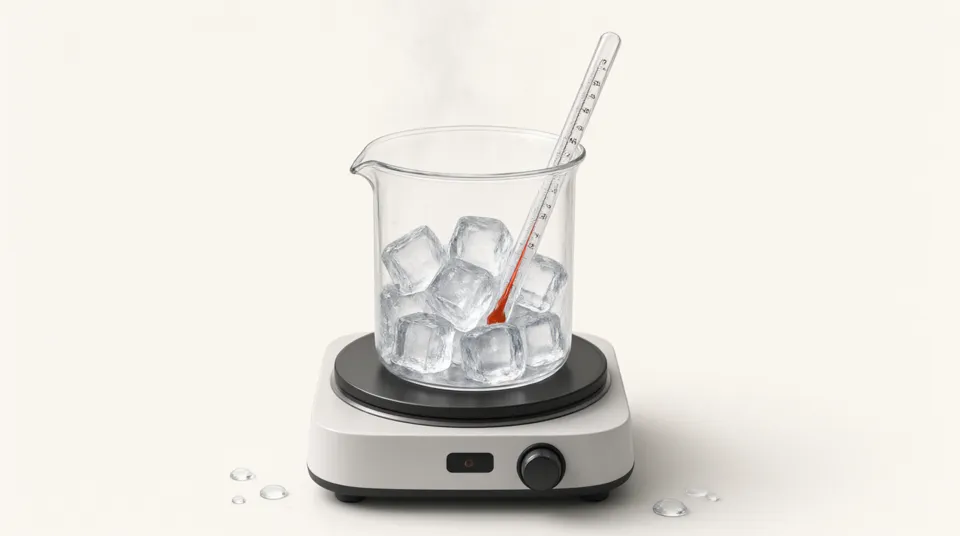
About this experiment
Put ice from a freezer on a hotplate and read a thermometer every minute. The temperature rises, then stops at 0 °C while the ice melts, rises again, and stops a second time when the water boils. This lab plots that heating curve as it happens and shows the particles inside. Change the mass, the heater power and the starting temperature, or carry the experiment up a mountain where water boils below 100 °C.
Learning goals
- Describe the shape of a heating curve and name the state of the water on each part
- Explain why the temperature stays constant while a substance melts or boils
- Use Q = mcΔT and Q = mL to calculate the energy for each stage
- Compare the energy needed to melt ice with the energy needed to boil water
- Relate the boiling point to the air pressure
How to use it
- 1Press Heat and watch the thermometer. Pause on each flat part of the graph and describe what is in the container.
- 2Use the particle view to describe how the arrangement and motion of the particles change in each state.
- 3Compare the lengths of the two flat parts. Which change of state needs more energy? Check with the readouts.
- 4Double the mass of ice. Which parts of the curve get longer? Then double the heater power instead.
- 5Compare the slopes of the ice, water and steam parts. Which substance has the largest specific heat capacity?
- 6Raise the altitude to the top of Mount Everest (8849 m). Find the new boiling point and explain why pasta cooks slowly there.
The model
Assumptions
- No heat is lost to the surroundings and all of the heater power goes into the water.
- The container is sealed by a piston, so the steam stays inside at constant pressure and can be heated further. In an open beaker the steam escapes and the last part of the curve is not seen.
- The water is stirred, so the whole sample is at one temperature. Specific heat capacities and latent heats are taken as constant.
- Air pressure falls with altitude with a scale height of 8.4 km. The melting point barely depends on pressure and is kept at 0 °C.
- The particle view is a picture of the arrangement and relative speed of the particles, not a molecular simulation.
Try this in class
- Q1How much energy is needed to melt 0.2 kg of ice at 0 °C?
- Q2A 1500 W kettle holds 1.2 kg of water at 20 °C. How long does it take to reach 100 °C if no heat is lost?
- Q3Why does a steam burn at 100 °C hurt more than a burn from boiling water at 100 °C?
- Q4Why is the line for liquid water less steep than the line for ice, even though the same heater is used?
- Q5In a real experiment the melting part of the curve is often sloped rather than flat. Suggest two reasons.
Frequently asked questions
Where does the energy go if the temperature does not change?
It increases the potential energy of the particles. Melting and boiling pull particles apart against the attraction between them, so the energy is stored rather than making the particles move faster. That stored energy is released again when steam condenses or water freezes.
Why is boiling so much longer than melting?
Melting only loosens the crystal; the particles in liquid water are still touching. Boiling separates them completely, which needs almost seven times as much energy per kilogram (2260 kJ against 334 kJ).
Can I do this experiment in class?
Yes, with crushed ice in a beaker, a stirrer and a thermometer over a Bunsen burner or hotplate, reading every 30 seconds until the water has boiled for a few minutes. Expect the plateaus to be less sharp than here because the beaker loses heat and is not evenly mixed.