About this experiment
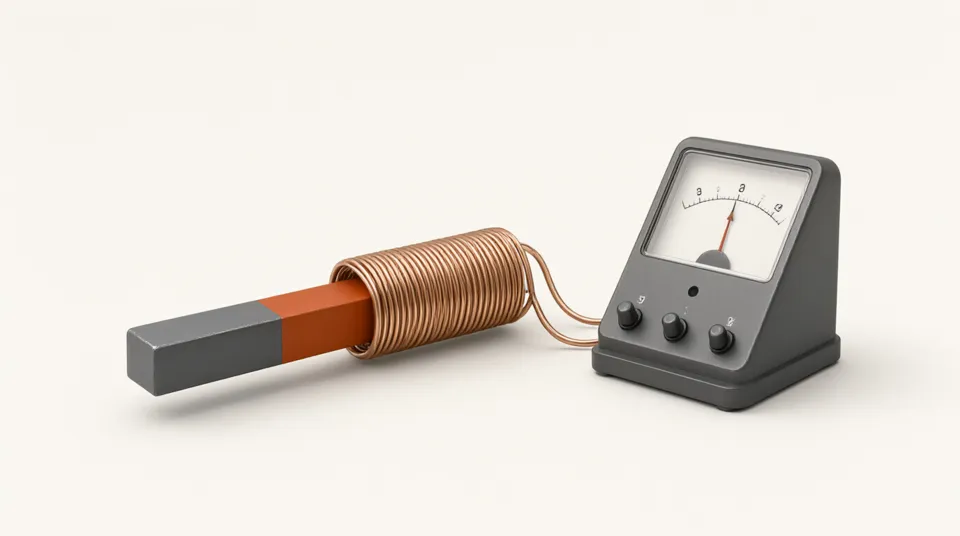
Push a magnet into a coil of wire and a current flows, even though there is no battery. Stop the magnet and the current stops; pull it out and the current flows the other way. Michael Faraday discovered in 1831 that a changing magnetic field through a coil induces a voltage. Move the magnet by hand, on a spring or straight through, and watch how the meter, the flux and the induced EMF depend on speed, the number of turns and the strength of the magnet.
Learning goals
- Describe how a changing magnetic flux through a coil induces an EMF
- Explain how the size of the induced EMF depends on speed, number of turns and magnet strength
- Use Lenz's law to predict the direction of the induced current
- Relate the EMF to the gradient of the flux linkage against time graph
- Explain how generators and dynamos make electricity
How to use it
- 1Choose By hand. Push the magnet into the coil, hold it still, then pull it out. When does the needle move?
- 2Move the magnet faster. What happens to the size of the current?
- 3Choose On a spring. Compare the two graphs. Where is the EMF largest: when the flux is largest, or when it changes fastest?
- 4Double the number of turns, then double the strength of the magnet. How does the peak EMF change each time?
- 5Choose Push through and watch the letters N and S at the ends of the coil. Does the coil push the magnet away or pull it back?
- 6Turn the magnet round and repeat. What happens to the direction of the current?
The model
Assumptions
- The magnet is treated as a magnetic dipole on the axis of the coil. This is accurate when the magnet is not much bigger than the coil; very close to the magnet the real field is weaker.
- The coil is 4 cm long with a radius of 2 cm, and its turns are spread evenly along its length.
- Magnetic braking is ignored: the current in the coil does not slow the magnet down. The self-inductance of the coil is ignored too.
- By hand, the magnet follows the pointer smoothly, so its speed depends on how fast you move.
Try this in class
- Q1Why does a magnet held still inside a coil produce no current, however strong it is?
- Q2When the magnet passes through the coil, the EMF has two peaks of opposite sign. Explain why.
- Q3Use Lenz's law to explain why it takes more effort to push a magnet into a coil when the coil is connected to a lamp.
- Q4A bicycle dynamo lights its lamp more brightly when you ride faster. Why?
- Q5Why would a coil with twice as many turns but made of thinner wire not necessarily give twice the current?
Frequently asked questions
What is the difference between flux and flux linkage?
Flux is the amount of magnetic field passing through one turn of the coil. Flux linkage is the flux times the number of turns, NΦ, because every turn adds its own EMF in series.
Why is the EMF zero when the magnet is in the middle of the coil?
At that moment the flux is at its largest but is not changing: moving a little either way changes it hardly at all. The EMF depends on how fast the flux changes, not on how big it is.
Where does the electrical energy come from?
From the work you do moving the magnet. By Lenz's law the induced current always makes a magnetic force that opposes the motion, so you have to push to keep the magnet moving. In this model that force is too small to slow the magnet noticeably.