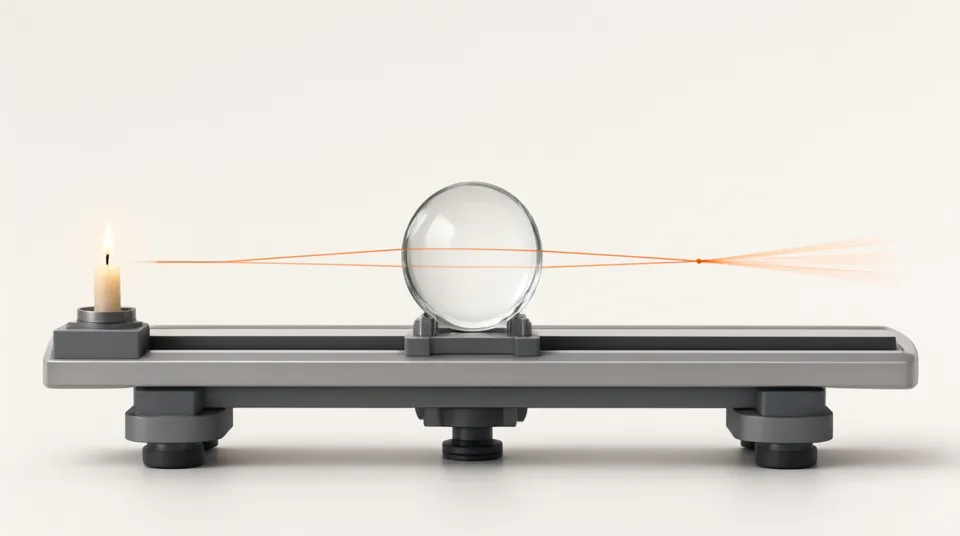
About this experiment
Slide an object toward a convex lens and watch the image change from small and inverted to large, then to an upright virtual image. Three principal rays are drawn live, so students can see exactly where the image forms and why. The panel highlights which of the five classic cases the current setup belongs to.
Learning goals
- Draw the three principal rays for a convex lens
- State the image properties for each object position relative to F and 2F
- Use the thin lens equation to calculate image distance and magnification
- Connect each case to a real device: camera, projector and magnifying glass
How to use it
- 1Drag the object arrow along the axis, or use the object distance slider.
- 2Watch the highlighted case in the panel change as the object crosses 2F and F.
- 3Drag a focal point to change the focal length and see the lens get thicker or thinner.
- 4Move the object inside F. The dashed lines trace the refracted rays back to the virtual image.
The model
Assumptions
- The lens is thin, so all bending is drawn at the center line of the lens.
- Rays stay close to the axis (paraxial), so aberrations are ignored.
- A negative image distance means the image is virtual and on the same side as the object.
Try this in class
- Q1Where must the object be for the image to be the same size as the object?
- Q2A projector makes a large image on a far screen. Which case is it using?
- Q3What happens to the image as the object moves very close to F from the outside?
- Q4Can a virtual image be shown on a screen? Explain using the rays.
Frequently asked questions
Why are only three rays drawn?
Every ray from the tip of the object passes through the tip of the image. Three special rays are easy to construct and two are enough to locate the image.
What is the difference between a real and a virtual image?
Light actually meets at a real image, so it can be caught on a screen. A virtual image is where the refracted rays only appear to come from.
Why is there no image when the object is at F?
The refracted rays leave the lens parallel to each other and never meet, so the image is said to be at infinity.