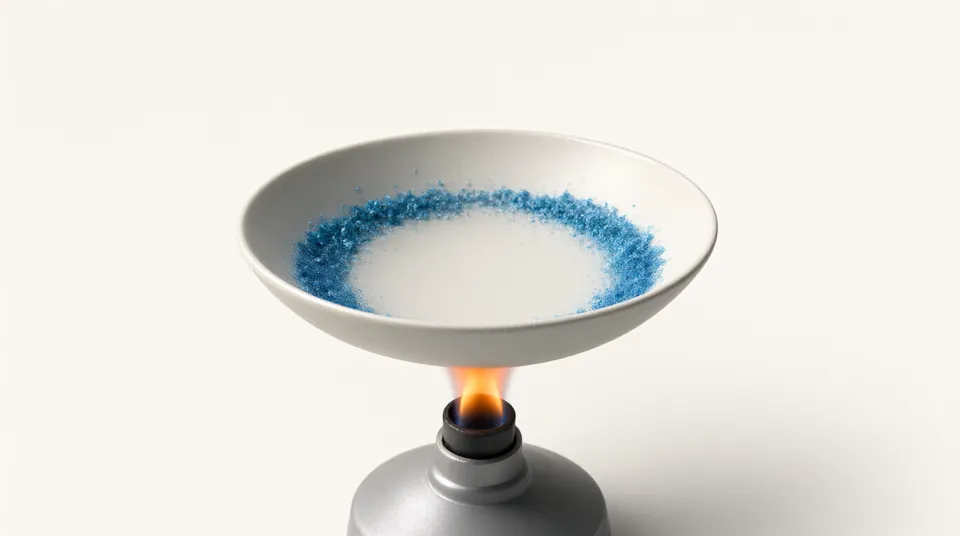
About this experiment
Use a transparent crystallizing vessel to compare cooling and evaporation. Both can reduce the amount of solute that remains dissolved, but they change different conditions. The experiment uses a stated linear solubility model for an illustrative material, so every crystal-mass prediction can be checked without relying on an unstated empirical table.
Learning goals
- Recover solute by cooling at fixed water mass, then by evaporation at fixed temperature. Check the solute balance.
- Use direct apparatus controls, numerical readouts and repeatable trials to test a prediction.
- Explain which physical effects are included and which are deliberately excluded.
How to use it
- 1Start with 40 g solute in 100 g water at 80 degrees Celsius. Confirm that all solute can dissolve.
- 2Cool to 20 degrees without evaporating water. Record crystal mass and dissolved mass.
- 3Reset to 80 degrees and evaporate 40 percent of the water. Compare with cooling.
- 4For each trial, add dissolved solute and crystals. Explain why this sum is unchanged even when total solution mass decreases.
The model
Assumptions
- The material is an illustrative ideal solute, not a fitted model for a named chemical. Solubility rises linearly from 20 g per 100 g water at 20 degrees Celsius to 50 g per 100 g water at 80 degrees.
- Solid-liquid equilibrium is immediate and seed crystals are available. Supersaturation, nucleation delay, crystal-size distributions and latent heat are excluded.
- Only water evaporates. Solute is nonvolatile and all solid and dissolved solute remains in the vessel. The crystal objects are a mass illustration, not counted molecules.
Try this in class
- Q1Why can crystal mass increase while total solute mass stays constant?
- Q2How much water must remain at 80 degrees to keep 40 g solute just dissolved in this model?
Frequently asked questions
Are these measured potassium nitrate data?
No. The solubility law is an explicit illustrative model. Real materials require their own measured solubility curves.
Why do crystals appear immediately when capacity falls?
The model assumes equilibrium and existing seed crystals. It does not predict nucleation time or growth kinetics.