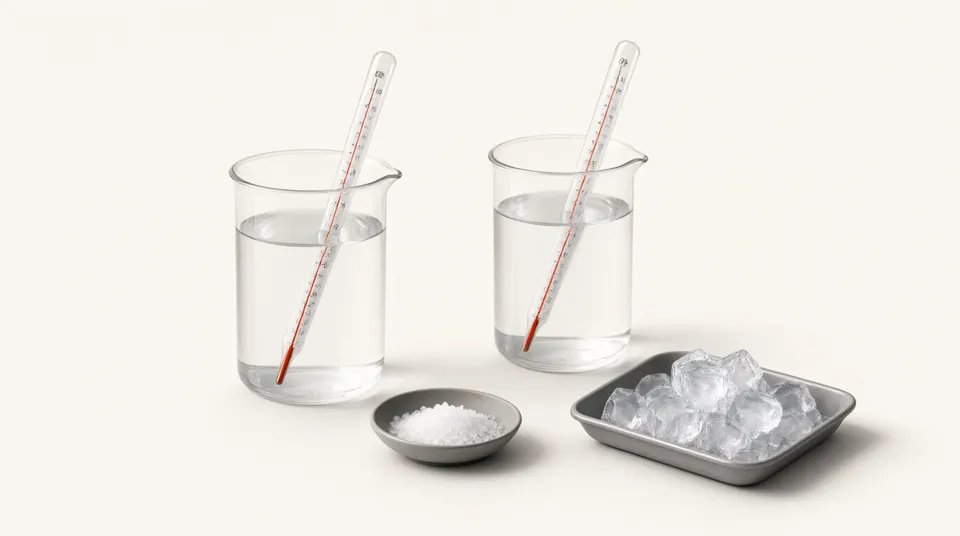
About this experiment
Dissolve a nonvolatile solute and compare its solution with pure water in a controlled bath. Measure how solute amount, solvent mass and dissociation affect freezing and boiling onset temperatures.
Learning goals
- Use molality rather than total solution mass in freezing and boiling shifts.
- Relate dissociation to effective dissolved-particle count.
- Distinguish an onset temperature from a calculated phase fraction or rate.
How to use it
- 1Compare glucose, sodium chloride and calcium chloride at the same molality.
- 2Change electrolyte dissociation fraction and observe the effective particle factor.
- 3Set the bath to each onset and compare the pure-water and solution markers.
- 4Add water to a fixed solute amount and record the reduced temperature shifts.
The model
Assumptions
- The solute is nonvolatile and remains dissolved. Ideal dilute-limit equations neglect activity coefficients, eutectics and solubility limits.
- Bath temperature is imposed. Ice and bubble markers identify possible onset conditions, not a computed amount frozen, boiling duration or evaporation rate.
- Water density is approximated as one kilogram per litre for the osmotic concentration. A warning marks molality above 0.5 mol per kilogram as a concentrated extrapolation.
Try this in class
- Q1Why do equal solute masses not give equal freezing-point depressions?
- Q2Why can real electrolyte solutions differ from the fully dissociated ideal prediction?
Frequently asked questions
Is a boiling-point elevation a prediction that the liquid can heat indefinitely?
No. It is an equilibrium onset relative to pure water at the same pressure. The bath control is not a thermal energy or evaporation calculation.
Why does undissociated glucose still change the freezing point?
Each dissolved glucose molecule is a solute particle. Dissociation is not required for a colligative effect.