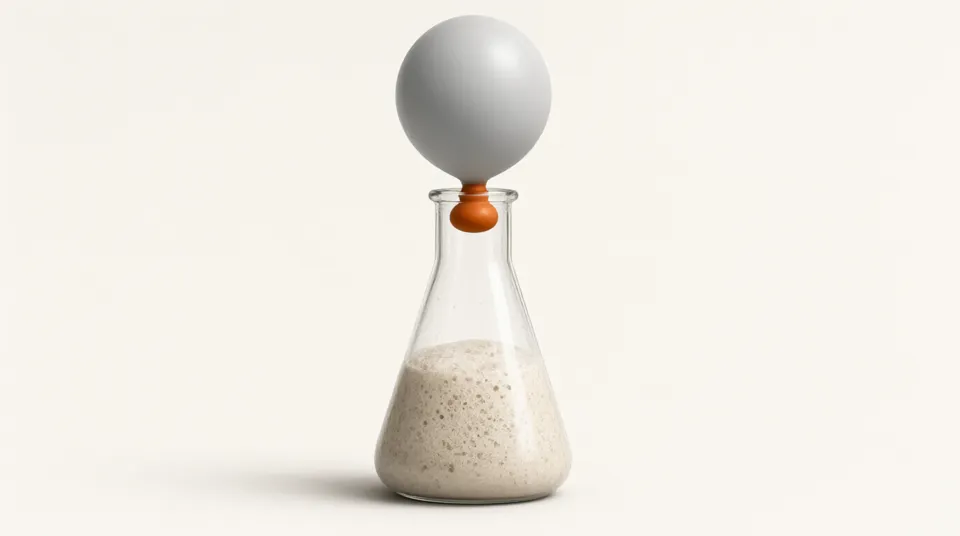
About this experiment
Use a virtual fermentation vessel and gas collector to investigate how sugar, yeast amount and temperature affect products. Divert new gas without erasing the amount already collected.
Learning goals
- Relate sugar consumption to ethanol and carbon dioxide mass.
- Distinguish generated gas from collected and vented gas.
- Compare rate effects with the total amount possible from a sugar supply.
How to use it
- 1Run an 80 g/L sugar trial for eight hours and record its products.
- 2Divert new gas now, then continue the run and compare collected with vented carbon dioxide.
- 3Increase yeast concentration and compare equal-duration trials.
- 4Change the sugar concentration and compare the remaining substrate and alcohol fraction.
The model
Assumptions
- The vessel is anaerobic, well mixed and at constant liquid volume with fixed active yeast biomass. Growth, respiration, death and inhibition are omitted.
- Substrate use follows an illustrative saturating rate with a 5 g/L half-saturation concentration and a Gaussian temperature response centred on 30 °C.
- Every mole of glucose consumed forms two moles of ethanol and two moles of carbon dioxide. The molar masses used sum exactly for mass accounting.
- All captured carbon dioxide is treated as dry ideal gas at 298.15 K and 1 bar. Dissolution and headspace delay are omitted.
- The displayed balloon radius uses logarithmic gas-volume scaling. Planned collection-cutoff edits recalculate collection history; the immediate diversion action retains collected products.
Try this in class
- Q1Why does ethanol continue increasing after gas diversion?
- Q2How does raising yeast concentration differ from adding more sugar?
Frequently asked questions
Does the balloon show the actual vessel pressure?
No. Gas is reported at a fixed reference temperature and pressure; the balloon is a volume symbol with compressed visual scaling.
Does hotter always mean faster?
No. This illustrative rate peaks at 30 °C, and the model does not represent all yeast strains or predict a real fermentation.