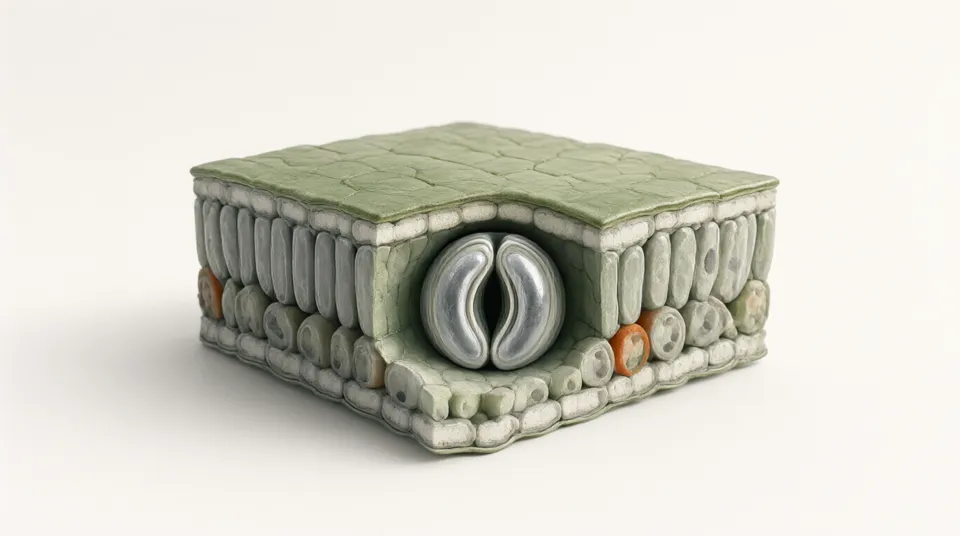
About this experiment
Explore a leaf section and manipulate its guard-cell opening. Compare how carbon dioxide access, light and humidity affect photosynthetic uptake and water loss while identifying the functions of the main tissues.
Learning goals
- Identify cuticle, epidermis, mesophyll, vascular tissue and stomata.
- Explain the carbon-gain and water-loss tradeoff of opening pores.
- Distinguish manual pore control from a complete physiological regulation model.
How to use it
- 1Click leaf layers and read their functions.
- 2Open and close the stomata while holding other conditions constant.
- 3Reduce light to zero and inspect uptake and water loss separately.
- 4Raise humidity to saturation and compare the water-use ratio.
The model
Assumptions
- The cutaway separates tissue layers for inspection; it is not a scale anatomical reconstruction.
- Conductance is 0.003 plus 0.2 times squared pore opening in mol air per square metre per second. Residual conductance represents unresolved surface pathways.
- A steady diffusion balance solves internal CO₂ together with a saturating light and internal-CO₂ uptake law. Photosynthetic respiration and the external boundary layer are omitted.
- Water-vapour conductance is 1.6 times the CO₂ conductance and uses the vapour-pressure difference at a total pressure of 101.3 kPa.
- Pore opening is manual. The model does not automatically close stomata in darkness or respond to hormones or leaf water status.
Try this in class
- Q1Why can manually open pores lose water even when photosynthetic uptake is zero?
- Q2Why is a water-use ratio undefined when water flux is zero?
Frequently asked questions
Why is there no Run button?
The displayed anatomy and gas fluxes are a steady-state experiment. Moving a control immediately prepares another state.
Does an open pore always mean a higher net carbon gain?
This model reports photosynthetic uptake without respiration. It does not predict whole-plant net gain or all stresses.