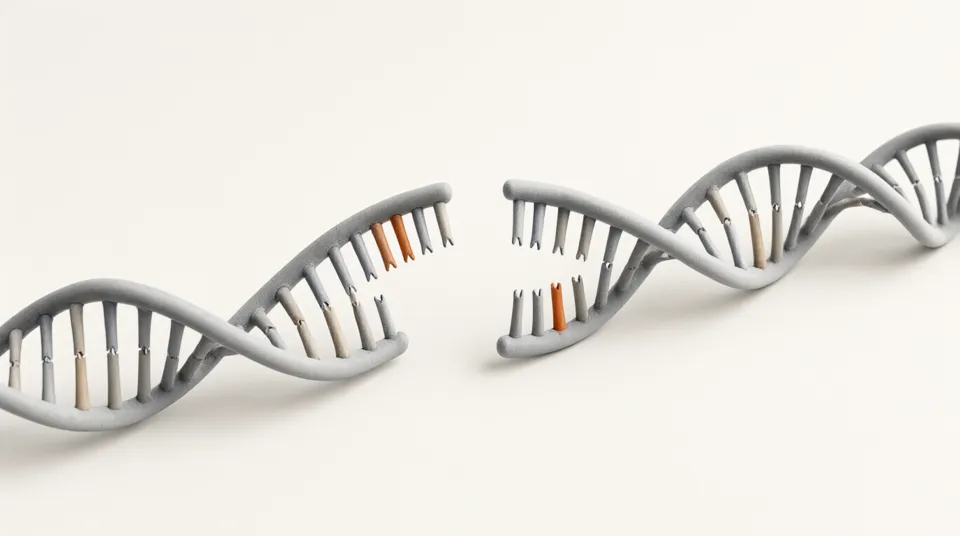
About this experiment
Open a DNA fork and choose nucleotides for two different synthesis orders. Leading synthesis follows the exposed template continuously, while lagging synthesis works backward within short exposed fragments. Wrong choices are rejected in this idealized exercise; ligation joins the completed fragments into a continuous daughter strand.
Learning goals
- Apply complementary pairing to both parental templates.
- Preserve the chemical 5′ to 3′ direction on both new strands.
- Explain semiconservative replication and the need to join lagging fragments.
How to use it
- 1Open one base pair and add the correct nucleotide to the leading strand.
- 2Expose three bases, switch to the lagging template and inspect the reverse order within its fragment.
- 3Try an incorrect base, then complete both products manually or run the deterministic demonstration.
- 4Ligate the fragments and verify that each daughter duplex retains one parental strand.
The model
Assumptions
- The displayed parental strand runs 5′ to 3′ in increasing index; its complement runs 3′ to 5′. Leading synthesis advances in increasing index, while lagging synthesis reverses index within each fragment.
- Three-base fragments keep the exercise inspectable and are much shorter than biological Okazaki fragments. Primers and their replacement are assumed; ligation closes nicks after all bases are present.
- The model isolates one fork and rejects every mismatched choice. Initiation, ATP use, topological stress, repair pathways and organism-specific polymerase kinetics are excluded.
Try this in class
- Q1How can two new strands both grow 5′ to 3′ while using antiparallel templates?
- Q2Which parts of each final duplex were already present before copying?
Frequently asked questions
Why can the lagging strand not begin after opening only one base?
Its next short teaching fragment begins at the far exposed end. The whole fragment must first be available.
Does an incorrect nucleotide become a mutation in this exercise?
No. Every mismatch is rejected. The separate mutation experiment studies edits that remain in a sequence.